
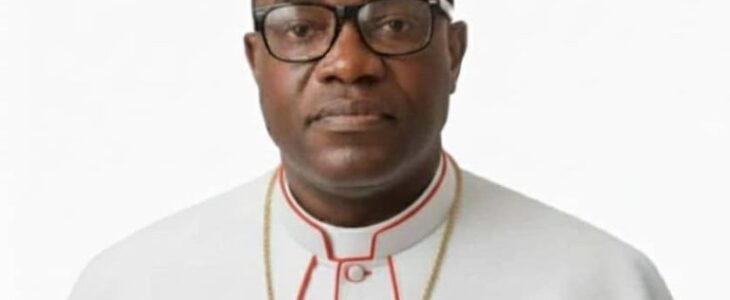
The Presiding Bishop of the Old Catholic Apostolic Church, Nigeria (OCAC), Most Rev. Dr Raphael Oluwaseun Fagbohun, has lamented the country’s rising insecurity, systemic corruption, and weakening institutions, calling on the President Bola Tinubu-led government to draw lessons from the leadership style and reforms of former President Olusegun Obasanjo to surmount the challenges in the country.
He maintained that Nigeria’s current crises demand bold leadership, institutional discipline, and moral courage similar to what was demonstrated during Obasanjo’s government.
Bishop Fagbohun made the call while commemorating his 22 years of priestly ordination and 11th Episcopal Installation Anniversary as the Pioneer Bishop of OCAC-Nigeria.

While reflecting on Obasanjo’s tenure as Military Head of State (1976–1979) and Civilian President (1999–2007), the cleric described the former president’s leadership as one of the most consequential periods in Nigeria’s political history, marked by decisive reforms and a commitment to national interest.
According to him, Obasanjo’s successful negotiation of Nigeria’s foreign debt relief, which slashed the nation’s debt from about $36 billion in 1999 to roughly $3.6 billion by 2007, remained a critical example of how political will and credibility can free resources for development.

He also submitted that Nigeria’s present economic strain, worsened by corruption and insecurity, could be addressed if government officials embraced similar fiscal discipline and transparency.
He recalled Obasanjo’s establishment of the Economic and Financial Crimes Commission (EFCC) and the Independent Corrupt Practices and Other Related Offences Commission (ICPC) to fight corruption, describing them as bold institutional safeguards that helped instil accountability in public life.
He warned that the weakening or politicisation of such institutions today has contributed to unchecked corruption and insecurity, stressing that effective law enforcement agencies must be strengthened rather than undermined.
The Bishop also brought to mind the liberalisation of the telecommunications sector in 2001, which introduced GSM services, created millions of jobs, and expanded economic opportunities, noting that inclusive economic growth remains a vital antidote to youth unemployment and violent crime.
The cleric further pointed to Obasanjo’s economic reforms, including banking consolidation, the Excess Crude Account, and prudent fiscal management, which boosted Nigeria’s foreign reserves from $3.7 billion to over $45 billion by 2007, while stabilising the economy.
On insecurity, Bishop Fagbohun recalled Obasanjo’s police reforms, particularly the introduction of the Chaplaincy system in the Nigeria Police Force, aimed at addressing the moral and psychological well-being of officers. He described the initiative as a neglected but critical component of national security architecture.
In terms of democratic governance, the Bishop praised Obasanjo for making history in 1979 as the first Nigerian military ruler to voluntarily hand over power to a civilian government, a gesture he said reinforced democratic culture and political stability.
Internationally, Obasanjo’s active diplomacy in conflict resolution in Liberia and the Democratic Republic of Congo, as well as his role in strengthening the African Union (AU) and NEPAD, were cited as examples of how strong leadership enhances national prestige and security.
Bishop Fagbohun urged present leaders to revisit Obasanjo’s earlier initiatives such as the Universal Primary Education (UPE) programme, Operation Feed the Nation (OFN), and critical infrastructure development, noting that education, food security, and infrastructure remain central to tackling insecurity..
Describing Obasanjo’s legacy as “a blend of courage, reform, and statesmanship,” the bishop said Nigeria’s way out of corruption and insecurity lies in strong institutions, accountable leadership, and moral renewal, with faith-based organisations playing a complementary role in nation-building.
“The challenges confronting Nigeria today are not insurmountable,” Bishop Fagbohun said. “What is required is leadership with vision, integrity, and the courage to place national interest above personal gain.”
The anniversary celebration, he added, serves as a moment of reflection on leadership, service, and the collective responsibility of government, religious institutions, and citizens in rebuilding the nation.
Credit: The Sun