
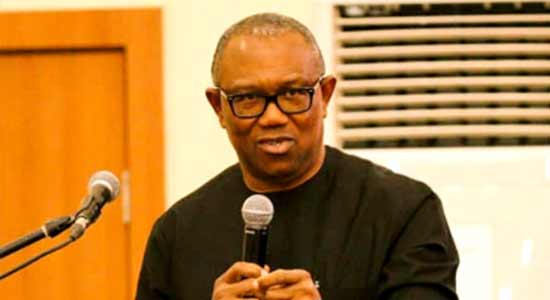
Former Anambra State governor and Opposition leader, Peter Obi, has described the $9 million spent on foreign lobbyists by the federal government as evidence of what he called the “disgraceful state of Nigeria,” accusing the country’s leaders of prioritising waste, propaganda and corruption over genuine development needs.
In a statement posted on his verified X handle on Friday, Obi described the expenditure as “tragic and concerning,” arguing that it reflected the broader failure of leadership and governance in the country.

“Recently, it was reported that $9 million of taxpayers’ money was spent on lobbyists in Washington, which I believe is just a small fraction of the global waste occurring in the same manner. This situation aligns with the disgraceful state of Nigeria.
“It is both tragic and concerning that our leaders continue to prioritize waste, corruption, propaganda, lies, and negative aspects of development over positive initiatives,” Obi said.

“This is merely a small example of wasteful spending that has contributed to our nation’s current failing status,” he stated.
Obi linked the issue of wasteful expenditure to Nigeria’s long-standing poor performance on the Human Development Index (HDI), noting that the country has remained in the low HDI category for 35 years, from 1990 to 2025.
“Nigeria has remained stagnant in the low HDI category for 35 years,” he said, contrasting the situation with countries such as China and Indonesia.
According to him, China and Indonesia, which were once in the same low HDI category as Nigeria, have progressed to medium and high development levels due to deliberate policy choices.
“China—where Nigeria had a three-fold higher per capita income in 1990—and Indonesia have advanced from low to medium, and now to high categories,” Obi noted.
“The achievements of these nations were not the result of fate, miracles, or natural endowments, but rather a consequence of choices and the cumulative effects of good and bad leadership.”
He stressed that development outcomes are driven by prioritisation, adding that Nigeria’s leaders have consistently failed to make the right choices.
Using the $9 million expenditure as a case study, Obi examined Nigeria’s failures across the three core components of HDI: health, education and income.
“To explain further the implications of the $9 million expenditure, let’s consider the components of HDI: life expectancy (health), education, and per capita income (poverty). Nigeria is failing in all three measures,” he said.
Focusing on healthcare, Obi said the $9 million, estimated at about ₦14 billion—could have been used to address Nigeria’s dire health indicators.
“Nigeria now has the lowest life expectancy in the world and ranks among the top two countries globally for maternal mortality, making childbirth one of the most precarious experiences for Nigerian women,” he said.
“Instead of investing in life-saving systems, we spend millions trying to obscure our failures.”
To illustrate his point, Obi cited budgetary allocations to six federal teaching hospitals across Nigeria’s geopolitical zones under the 2024 capital budget.
He listed ₦2.67 billion allocated to the University College Hospital, Ibadan; ₦2.46 billion to Ahmadu Bello University Teaching Hospital, Zaria; ₦2.8 billion to the University of Nigeria Teaching Hospital, Enugu; ₦2.43 billion to the University of Benin Teaching Hospital, Benin City; ₦1.16 billion to the University of Ilorin Teaching Hospital; and ₦2.37 billion to the University of Maiduguri Teaching Hospital, amounting to a total of ₦13.9 billion.
“Our key medical centers are teaching hospitals,” Obi said, adding that the $9 million spent on lobbyists “could have been used wisely to purchase essential hospital equipment for Nigerian hospitals, improving our healthcare capabilities and positively influencing our national image.”
He further argued that the amount spent abroad was enough to fund the entire 2024 capital budget of at least one major teaching hospital in each geopolitical zone.
“This $9 million is sufficient to fund the entire 2024 capital budget for at least one major teaching hospital in each zone, directly enhancing survival rates, care, and life expectancy,” Obi stated.
According to him, Nigeria’s problem is not a lack of funds but a lack of discipline and effective leadership.
“The funds are available; what is lacking are prioritization, discipline, and effective leadership,” he said.
Obi described the situation as unacceptable, warning that Nigeria cannot continue to mask its internal failures with external public relations efforts.
“Every naira of taxpayers’ money should serve the Nigerian people,” he said. “Instead, citizens are dying in failing hospitals while the government pays foreigners to pretend that everything is fine.”
He concluded by calling for an end to what he described as the government’s obsession with trivial and cosmetic priorities.
“We cannot continue to live in an illusion while our reality deteriorates. This constant prioritisation of trivial matters must come to an end,” Obi stated.
Credit: Leadership