
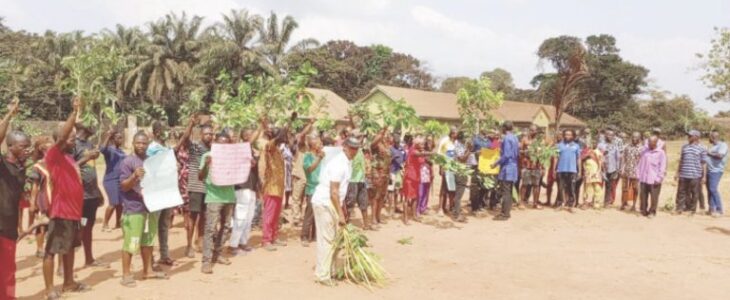
For years, the people of Ochima community in Igbo-Etiti Local Government Area of Enugu State say they have lived with the unsettling sound of gunfire from a nearby military shooting range.
But the tension in the quiet agrarian village boiled over when soldiers allegedly began fencing off more than 540 hectares of land which residents insist belongs to their forefathers.

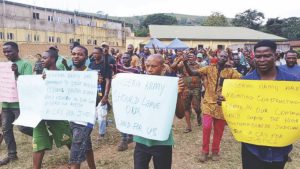
What followed was an outpouring of anger and frustration, as villagers took to the streets in protest, voicing fears not just about the loss of their land, but about their livelihoods, their heritage and the uncertain future of a community that prides itself as one of the oldest in the Nsukka cultural zone.
Placards bearing inscriptions such as ‘Army, leave our land;’ ‘Respect court order;’ ‘Stop destroying our farms;’ and ‘Ochima is not a military range,’ were hoisted high as villagers moved through the narrow village roads.

While the demonstration remained peaceful, the emotion behind it was unmistakable. Many of the protesters insisted that the dispute goes beyond land ownership. For them, it is about survival, identity and the preservation of a community they say has existed long before Nigeria itself.
The protest provided a rare moment for many residents to publicly narrate their experiences in a conflict they claim has dragged on for over a decade.
Standing before the crowd during the protest, the President General of Ochima Town Union, Gerald Ubaka, an engineer, traced the origins of the crisis to around 2010 when a communal conflict between neighbouring communities reportedly prompted the Nigerian Army to intervene.
According to him, the military’s intervention gradually transformed into what the community now describes as a systematic takeover of their land.
“The Nigerian Army started doing this around 2010 after the fight between Affa and Umuna along the expressway.
“So the army, after settling the fight, said they were working on the land that was causing the problem. Then they started coming to our land. We told them that the place where people were fighting was along the expressway, but they continued coming to our farmland.
“The army started putting signposts that we should keep off, that it is Nigerian Army land.
“We asked what happened and they said it is their land. But this is the land where I was born. My fathers and grandfathers were born here. Ochima is the oldest community in Nsukka. So there is no way you can tell me that this is Army land,” he said.
Ubaka explained that the community initially avoided a confrontation with the military but repeatedly sought intervention from government authorities.
“After that they started putting beacons on our land. Because we cannot fight them, we started reaching out to the local government and the state government but nothing was done.
“It was in 2016 that they started building their shooting range on the land. Again, we cried out to the state government and the local government but nothing happened.”
With their appeals apparently ignored, the community eventually turned to the courts.
“So we consulted a lawyer and took the matter to court to see if we can get justice from there. The court process was going on but the shooting range was going on too. Our lives are at risk. We cannot sleep peacefully any longer.”
He narrated a tragic incident the community claims resulted from the military firing range.
“Some time ago, a bullet hit a woman farming in a neighbouring community. The woman later died.”
Youths in the community say the situation has created constant fear.
The youth leader, Chukwudi Ugwu, said villagers often run for safety whenever gunshots are heard.
“The Nigerian Army just invaded our land, the only land we have. There was no time our forefathers sold land to the Nigerian Army. We never had any agreement with them.
“At times they will start shooting and we keep running from place to place. We are calling on all Nigerians everywhere to come to our rescue,” he said.
Legal representatives of the community insist that the matter is already before a court and that both parties are expected to maintain the status quo pending the determination of the suit.
Senior Advocate of Nigeria, Gabriel Okafor, who is involved in the matter, said the court had issued a clear order restraining all parties from further development on the disputed land.
“The high court has asked everyone to maintain the status quo until the matter is resolved. But what are we seeing now? From nowhere, they mobilised and started fencing round the village. They came with all manner of intimidation.”
Okafor expressed concern over what he described as disregard for the rule of law.
“This is unprecedented but we must have to resist it. I thought that in a place where there is rule of law that everyone would stay where they are. But they mobilised and started fencing up the whole village.”
He added: “How would people feel when they wake up and see soldiers everywhere fencing their village? So we are not happy about it.”
According to him, the community had written to several authorities before approaching the court.
“We wrote to the Chief of Army Staff, we wrote to the Chief of Defence Staff. We gave them notices even before we went to court,” he said.
“We told them what we were going to do but they never replied. It is unfortunate that we have this kind of situation in Nigeria.”
Beyond the legal arguments, villagers say the dispute has already begun affecting daily life in the community.
Residents claim they have been barred from accessing farmlands, streams and sacred sites used for traditional worship.
Community elder, Chief Nnajiofor Oluka, described the loss of cultural sites as deeply painful.
“We just saw them moving in to take our land. We never had any agreement with them.
“The most annoying part is the place where we worship has been taken over. We have what is called Odo masquerade. The point where this masquerade comes home from has been taken over.”
He added: “All the places where we worship our ancestors are gone. We are the eldest community in Nsukka. How can we explain this?”
According to him, even basic resources have been affected. “Even our only source of water has been taken over. Nothing is left for us if the army takes everything from us.”
The traditional ruler of the community, Igwe Hyacinth Ezechinyere, said the community had repeatedly sought clarification from the military about how the land was acquired.
“We told the army that this place cannot contain us and that if there is anyone who sold the land to them they should let us know. We wrote to the local government chairman and to the state governor but they did nothing,” the monarch said.
He said the military later explained that the fencing was intended to prevent stray bullets from reaching the village.
“They came back and said they want to build a fence because when they shoot the bullets get to where we live.”
But some residents say they had never previously heard of any land belonging to the army within the area.
One of the community members, James Odoh, said the development came as a shock.
“Since I was born, I have never heard that we have boundary with the army or that they own any of our lands. We are the eldest in Nsukka as a whole,” he said.
For many women in the community, the impact of the dispute is felt most directly through the loss of farmland. One widow who spoke during the protest recounted how soldiers allegedly destroyed crops on her late husband’s farm.
“Soldiers came to our community and took our land. They came to my husband’s land and destroyed everything. The cassava in that land is what we use to feed and train our kids. Even other cash crops have been destroyed by the army.”
She said the loss of farmland has pushed many families to the brink. “They have also taken over our only source of water. There was a time when we found an exploded bomb in the farm. It was policemen who came to take away that bomb.
“When they shoot, bullets fall into our homes. We are begging everyone to help us. My husband is dead, and the only place from where I am taking care of our children has been taken away from me by the army.”
The legal dispute surrounding the land is captured in Suit No. OG/ HYPERLINK “tel:62023” \t “_blank” 6/2023, filed at the High Court of Enugu State sitting in Ogbede. Court documents indicate that the plaintiffs, including the traditional ruler and community leaders, are suing on behalf of the people of Ochima Community against the Nigerian Army, the Chief of Army Staff and the Attorney General of the Federation.
In a ruling delivered on February 24, 2025, Justice C. A. Ogbuabor granted an interlocutory injunction restraining both parties from continuing any building project on the disputed land pending the determination of the substantive suit.
The court order stated in part: “That Interlocutory injunction is granted restraining both parties from dealing with or interfering with the res or continuing with any building project on the land pending the hearing and determination of the substantive suit.”
The court also joined the Attorney General of Enugu State as the fourth defendant and directed that the matter be given accelerated hearing.
Despite the court order, the community insists that activities on the land have continued.
In a petition addressed to the Chief of Army Staff and the Minister of Defence, the Ochima Town Union accused soldiers of invading the community and ignoring the court’s directive.
The petition states in part: “We write on behalf of the indigenous and peace-loving people of Ochima Community in Igbo-Etiti Local Government Area of Enugu State to formally petition Your Excellency over the continued unlawful invasion, intimidation, harassment and economic strangulation of our community by armed personnel of the Nigerian Army, 82 Division, Enugu.”
The community alleged that soldiers entered the village in December 2025.
“About 35 heavily armed soldiers from the 82 Division invaded Ochima Community in the early hours of December 14, 2025. The soldiers fired gunshots indiscriminately before commencing the erection of a perimeter fence designed to cut off the community from its farmlands, water sources and major worship sites.”
The petition further claimed that soldiers allegedly took over economic activities within the community.
“The soldiers further drove away community youths lawfully appointed to regulate sand excavation from the community hill, took over the activity, sold sand to tipper drivers and collected the proceeds. They also harvested and carted away villagers’ food crops and reportedly cut and sold economic trees belonging to the community.”
The community also questioned the scale of land allegedly being acquired.
“The land space being fenced-in by the army for a shooting range is approximately 4, 535 hectares. It remains unimaginable how this much land space would be required for just a shooting range.
“Between 2023 and 2025, about three unexploded military bombs have been found within the community.”
When contacted, the Nigerian Army, through the office of the Acting Deputy Director, Army Public Relations, 82 Division, Lt. Col. Olabisi Ayeni, acknowledged the enquiry and said a response would be provided after obtaining approval from the General Officer Commanding.
However, as of the time of filing this report, several days after the enquiry was made, the Army had yet to issue an official response.
Credit: The Sun