
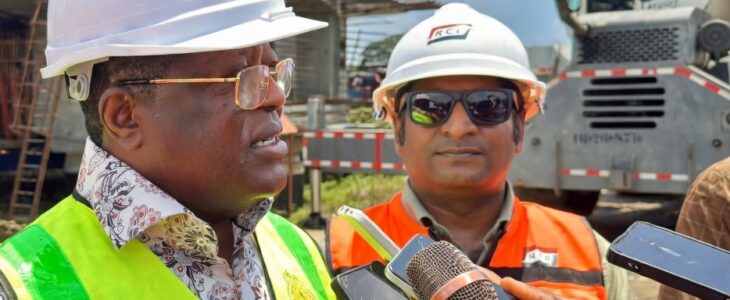
The federal government directed that the Enugu–Onitsha Expressway be reopened for public use on or before March 31.
“I have given the controller the authority. By the 31st or before, he should call the press to open this road. Call the people of South-East, let them know that this road is open for travel, and that will be our Easter celebration,” Minister of Works, Senator David Umahi, declared during an inspection of ongoing projects in Enugu, including the Enugu–Onitsha Expressway and the Eke-Obinagu Flyover.
Umahi expressed confidence that the era of frequent fatal accidents, endless traffic, and public frustration along the expressway is coming to an end.
“I’m going around the six geopolitical zones assessing what is possibly to be commissioned before May 29 by the president. There are mega projects that the president will be available for before May 29, and we mean it,” he said.

Once regarded as one of the region’s most dangerous highways, the Enugu–Onitsha Road had long been plagued by tanker explosions, fatal accidents, and economic disruptions. Umahi said decisive intervention by the Tinubu administration has changed the trajectory.
“Now, this route, the Enugu-Onitsha Expressway, you’ll recall that when we came on board, every day people were talking about this road. There were a lot of tanker accidents, many lives lost, and so forth. But my joy is that the whole thing is a past story, because the president has swung into action,” he stated.
The dual carriageway, spanning 107 kilometres on each side, is undergoing a major structural upgrade, with a significant portion being converted from asphalt to concrete for greater durability.
“It is not only that we are repairing this road, about half of it is going to be concrete. I have no confidence in asphalt. By the time the asphalt fails, we will have 50 per cent of the road still intact. And if it fails within the second tenure of the president, rest assured we will fix it,” Umahi said.
The same approach is being applied to sections in Anambra State, including the Head Bridge axis, where an initial asphalt design is being replaced with concrete pavement to meet modern highway standards.
“At the Head Bridge we have 39 kilometres. We’re changing that to concrete so that we can have this coastal-road type of pavement there in Anambra and here in Enugu,” he added.
Beyond reconstruction, the project is also being enhanced with solar-powered street lighting and environmental features to improve safety and sustainability.
“So that is going to happen. But not only that, we are putting solar lights both for the sections constructed before us and the ones being done by us. Within the first week, we will have solar light up to this 1km, and we are also going to plant trees, which is very important,” Umahi noted.
The minister urged South-East residents to appreciate the federal government’s intervention, which he said was long overdue.
Describing the works as part of a broader effort to correct past neglect, Umahi said they would integrate the South-East more fully into national development.
Addressing project cost concerns, Umahi clarified that pricing approvals pass through multiple regulatory layers, including the Bureau of Public Procurement and the Federal Executive Council.
“I’m not the final authority when it comes to the cost of a project. There are layers of approval, the Bureau of Public Procurement, their own stands, not mine,” he explained.
He added that the standard applied to the Enugu–Onitsha project is consistent with other major road projects across the country.
“The same road architecture as the Lagos–Calabar Coastal Highway and the Sokoto–Badagry Super Highway, so no discrimination. Everybody is the same,” Umahi said.
Credit: The Sun