
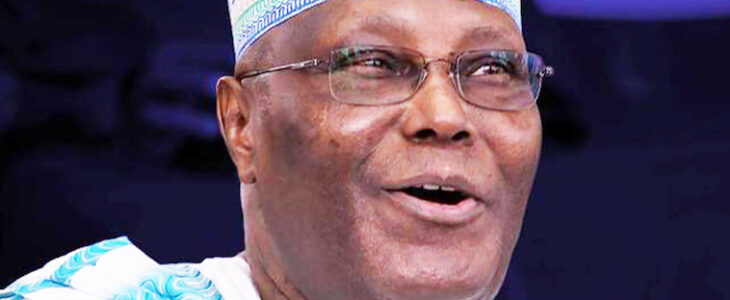
Former Vice President and chieftain of the African Democratic Congress (ADC), Atiku Abubakar, has expressed deep concern over reports that the Senate approved President Bola Tinubu’s request for a fresh $6 billion external loan within a record time—reportedly less than four hours after its presentation.
Atiku, in a statement issued by his Senior Special Assistant on Public Communication, Phrank Shaibu, on Tuesday, described the development as not just troubling but alarming.
He noted that a decision of such profound national consequence, one that will further burden an already strained economy and mortgage the future of generations yet unborn, cannot be treated with such reckless urgency.
“What Nigerians have witnessed is not legislative diligence, but a disturbing erosion of oversight responsibility,” he said.

He stressed that the National Assembly was not designed to function as a mere rubber stamp but as a constitutional safeguard meant to interrogate, scrutinise, and protect the interests of the Nigerian people.
“The Senate, which ought to serve as a constitutional safeguard, has instead reduced itself to a conveyor belt—processing requests of grave national consequence without due diligence. Borrowing decisions that will bind generations yet unborn cannot, and must not, be treated with this level of casual urgency.
“Where was the debate? Where was the rigorous analysis? Where was the accountability?” Atiku queried.
He warned that approving a multi-billion-dollar borrowing request in record time, without visible scrutiny, raised serious questions about due process and the commitment of the legislature to its constitutional duty.
While these objectives may appear routine on the surface, Atiku warned that they expose deeper structural weaknesses in the nation’s fiscal management.
“Resorting to fresh borrowing to service existing debts, plug budget gaps, and meet routine obligations is not a strategy—it is a dangerous cycle. It reflects a troubling absence of fiscal discipline, clear prioritisation, and sustainable economic planning,” he said.
He further anchored his concerns on emerging fiscal indicators, noting that between January and February 2026, the World Bank reported that Nigeria’s exposure to the International Development Association (IDA) had risen to $18.7 billion—placing the country among the largest recipients of concessional loans globally.
“In March 2026 alone, the President is requesting an additional $6 billion external loan, even as the Debt Management Office continues aggressive domestic borrowing through high-volume bond auctions, as evidenced by the March 2026 FGN Bond Offer Circular, largely to finance immediate government obligations and service existing debt,” he added.
According to Atiku, this pattern reflects an unsustainable borrowing trajectory that places the country on a dangerous fiscal path.
The former Vice President further questioned whether the development signals a deliberate attempt to mortgage the future of the country.
“Because that is what it suggests,” he added.
“What does a government that appears to be preparing for electoral rejection in 2027 intend to do with an additional $6 billion in borrowed funds—on top of the mounting obligations it has already accumulated in just the first quarter of 2026?”
Atiku emphasised that at a time when Nigeria’s debt profile continued to rise and debt servicing consumed a significant portion of national revenue, prudence—not haste—should guide fiscal decisions.
“Borrowing is not inherently wrong, but reckless borrowing, enabled by legislative complacency, is dangerous,” he said.
He added that the speed of the approval suggested a troubling sense of desperation—one that does not inspire confidence in the long-term economic direction of the country.
“Nigeria is not a private enterprise to be leveraged at will. The future of our nation cannot be signed away in a matter of hours,” he stated.
Atiku called on the Senate to remember its constitutional role as a check on executive excesses, not an extension of it, insisting that Nigerians deserve transparency, accountability, and responsible governance.
He concluded by noting that history will record this moment—and the choices made.
LEADERSHIP earlier reported that President Bola Tinubu had written to the Senate seeking approval to borrow a total of $6 billion to support Nigeria’s fiscal and infrastructure needs.
In a letter addressed to the President of the Senate, Godswill Akpabio, and read during Tuesday’s Senate plenary, the President requested approval for a $5 billion loan facility from Abu Dhabi Bank.
The funds were intended to cover the budget deficit and support debt financing, among other obligations.
In a separate communication, Tinubu also sought Senate approval to secure a $1 billion loan facility from London Citi Bank under a UK Export Finance (UKEF) arrangement.
The loan was designated for the rehabilitation of key port infrastructure, including the Lagos Port Complex and Tin Can Island Port.
According to the President, the port rehabilitation project aimed to address critical infrastructure deficiencies, improve operational efficiency, enhance safety standards, and support Nigeria’s non-oil trade diversification.
It is also expected to strengthen the country’s position as a regional trade hub.
Following the presentation of the letters, Senate President Akpabio immediately referred the requests to the Senate Committee on Local and Foreign Debts, chaired by Senator Aliyu Wamakko, for further legislative consideration and to immediately report back to the House.
Credit: Leadership