
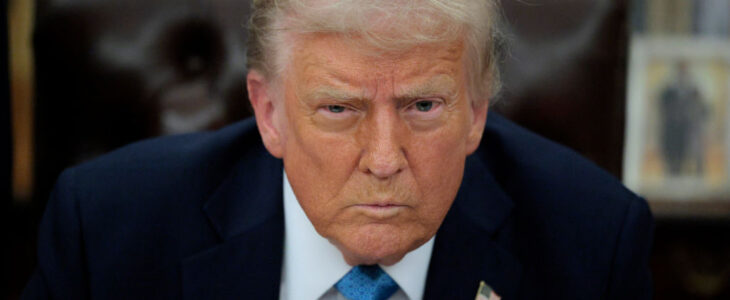
President Donald Trump was persuaded to unleash war on Iran by Israeli Prime Minister Benjamin Netanyahu despite deep skepticism from his inner circle, according to a new report about the high-stakes meetings that took place in the buildup to the conflict.
The also reported that despite polling his top advisers, he often only heard “what he wanted to hear,” and his team wound up serving as an echo chamber for his gut instincts.

Vice President JD Vance was the most vocal in his opposition to the United States going to war with Iran, while CIA Director Jim Ratcliffe, Secretary of State Marco Rubio and Gen. Dan Caine, Chairman of the Joint Chiefs of Staff, warned Trump that Netanyahu had “oversold” him on what could be achieved by the bombing campaign, according to
None of them, though, except Vance, went as far as to say to the president that war was a “terrible idea,” according to the report. The vice president is said to have played a key role in negotiating a ceasefire between Iran and the U.S. as Trump threatened to wipe Iranian civilization off the map.

On Feb. 11, the Israelis gave a secret presentation to Trump and his closest advisers in the Situation Room, where they persuaded him that initiating a war on one of the most hostile regions in the world was a good idea, according to the Times report, which is based on reporting from the upcoming book, Regime Change: Inside the Imperial Presidency of Donald Trump by Jonathan Swan and Maggie Haberman.

“Sounds good to me,” Trump reportedly told Netanyahu after the presentation, which the leader then took as a likely “green light” for the joint U.S.-Israeli operation that has since killed more than 3,500 people, including 1,600 civilians and 13 U.S. service members in the Middle East.
But at a follow-up meeting on Feb. 12 that consisted only of the Americans, U.S. intelligence officials broke down Netanyahu’s presentation into four parts; killing Ayatollah Ali Khamenei; destroying Iran’s capabilities to project power; a popular uprising inside the country, and regime change with a secular leader installed, according to the report.
While U.S. officials deemed that parts one and two were achievable, Ratcliffe said regime change as an objective was “farcical.”
“In other words, it’s bull****,” Rubio reportedly weighed in, while Vance “expressed strong skepticism” about the prospect.
Caine took it further and said the president had been “oversold” by the Israelis. “Sir, this is, in my experience, standard operating procedure for the Israelis,” Caine said, according to the Times. “They oversell, and their plans are not always well-developed. They know they need us, and that’s why they’re hard-selling.”
The Independent has contacted the White House for comment.


Over the following days, Caine reportedly shared with Trump “the alarming military assessment” that waging war with Iran would “drastically deplete” stockpiles of American weapons. In particular, he warned about supplies of missile interceptors, which had been strained after supporting Ukraine and Israel. Vance shared the same concern.
Caine also “flagged the enormous difficulty of securing the Strait of Hormuz and the risks of Iran blocking it,” and yet Trump “dismissed” the possibility. The president assumed that Iran would surrender before it got to that point, according to the report.
But Iran’s grip on the Strait has remained intact, with the regime blocking vessels that transport a fifth of the world’s oil, likely prompting Trump to post an expletive-laden Truth Social over the weekend.
While Caine gave Trump these warnings, “at no point during the deliberations did the chairman directly tell the president that war with Iran was a terrible idea,” the Times reports.
Two days before Trump gave the order to bomb Iran on February 28, he gathered the most senior members of his team and went around the room “one by one” to ask them for their personal opinions about going to war.
But by this point, Trump had “effectively made up his mind weeks earlier, several of his advisers said,” according to the newspaper.
Vance, who told Trump that going to war with Iran could unleash regional chaos and create mass casualties, also warned him that it risked splitting his base — and that it could be seen as “a betrayal” by many of his voters.

White House communications director Steven Cheung also spoke of the “likely public relations fallout” given Trump campaigned on being opposed to launching wars overseas, according to the report.
Ultimately, Cheung reportedly said that “whatever decision Trump made would be the right one.”
Trump’s chief of staff Susie Wiles reportedly told colleagues that “she worried” about the U.S. “being dragged into another war in the Middle East,” but opted to “sit back” in the high-stakes meeting. According to people close to her, she believed it was not her place to air those concerns to the president in front of others and instead encouraged military advisers to share their expertise with him.
White House counsel David Warrington, who represented Trump during the House select committee investigation into Jan. 6, was pressed by the president to share his personal view.
“He said that as a Marine veteran he had known an American service member killed by Iran years earlier,” the Times reports. “This issue remained deeply personal. He told the president that if Israel intended to proceed regardless, the United States should do so as well.”
The White House declined to comment when approached for comment by the newspaper.
Credit: Yahoo News