
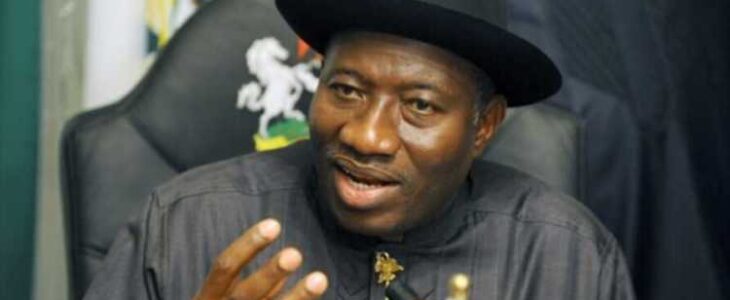
Former President Goodluck Jonathan has warned that Nigeria’s democracy faces a deepening legitimacy crisis if the judiciary continues to determine electoral winners instead of the ballot box, declaring that politicians now rush to court after elections because they believe judges can be manipulated to overturn the will of the people.
Jonathan spoke on Wednesday at the opening ceremony of the Nigerian Bar Association Abuja Law Week 2026, held at the NBA House in Abuja, under the theme, ‘Safeguarding Nigeria’s Democratic Process’.

Attending as Special Guest of Honour, the former president used the occasion to deliver what amounted to a pointed diagnosis of the systemic ailments threatening the country’s democratic foundations ahead of the 2027 general elections, touching on judicial independence, electoral integrity, voter apathy, political thuggery and the urgent need for institutional reform.
Jonathan painted a stark picture of a country where post-election litigation has become so normalised that it now constitutes a parallel system of determining political power.

Drawing a pointed comparison with South Africa, he recounted how a former South African deputy president expressed bewilderment upon learning that Nigerian politicians routinely challenge election outcomes in court.
“She asked me, ‘Why would somebody go to court after losing an election?’ In South Africa, going to court after losing an election is strange. While in Nigeria, not going to court is strange,” he said.
The former president argued that courts should not declare winners in disputed elections but should instead order fresh polls where irregularities are established.
“The judiciary will do their work, but they should not declare any candidate. If they are not satisfied with the process of the election, then they should go back to the field. Let the ballot decide who wins,” he stated.
Jonathan also raised questions about the consistency of Nigeria’s multi-layered electoral litigation structure, noting an apparent contradiction in how disputes are handled at different levels of government.
“Governorship election takes three levels, tribunal, Appeal Court and Supreme Court. Presidency takes two. Are you telling me electing a governor is more important than electing a President?” he asked.
He lamented that Nigeria recorded the lowest voter turnout on the African continent despite being the most populous nation on the continent, and called on the Independent National Electoral Commission to investigate the root causes beyond the commonly cited explanation of voter apathy.
He attributed part of the erosion of public trust in elections to political thuggery, which he said had become a normalised and, in some circles, financially rewarding profession.
“Nigeria is the only country where thuggery is a profession. Some thugs, when they are travelling out of this country, fly first class while university professors struggle to buy economy tickets. That country is like a canoe turned upside down,” he said.
Jonathan further urged the NBA to collaborate with the National Assembly in reviewing Nigeria’s electoral and judicial laws, and floated the idea of establishing a Constitutional Court dedicated exclusively to the resolution of electoral disputes.
In his keynote address, former Attorney General of the Federation and Minister of Justice, Mohammed Adoke, warned that Nigeria’s democracy was standing at a precarious crossroads, with public confidence in elections continuing to erode despite more than two decades of unbroken civilian rule.
Adoke argued that the mere continuity of elections did not amount to democratic credibility, stressing that the more fundamental question was whether citizens genuinely trusted the outcomes.
He cited the 2023 general elections, during which voter turnout stood at only 27 per cent, the lowest since 1999, while electoral violence claimed 89 lives.
According to him, vote-buying, electoral violence, weak internal party democracy and poor enforcement of electoral laws had combined to hollow out the country’s democratic process.
“Vote-buying has transformed elections into economic transactions rather than democratic choices,” he said.
Adoke also criticised political parties for allegedly imposing candidates and circumventing the democratic primaries mandated by the Electoral Act 2022, warning that overreliance on the judiciary to resolve political disputes was gradually stripping voters of their rightful role in determining who governs them.
“The phrase ‘go to court’ has become a silent reminder that the electorate’s participation in determining leaders is gradually eroding,” he stated.
He reserved praise, however, for Jonathan’s conduct during the 2015 presidential transition, describing him as a democratic legend who chose national peace over personal ambition at a critical moment in the country’s history.
President of the Nigerian Bar Association, Afam Osigwe, SAN, said it was deeply troubling that 27 years after Nigeria’s return to civil rule, safeguarding democracy remained the dominant anxiety in national conversation.
Osigwe said the increasing role of the judiciary in determining electoral outcomes was a matter of serious concern, warning that power must never be obtained outside constitutional and democratic processes.
“Without people mounting a military coup, people through violence, thuggery and electoral manipulation come to power in Nigeria,” he said bluntly.
He commended Jonathan for his peaceful concession of defeat in 2015, recalling the former president’s declaration that his ambition was not worth the blood of any Nigerian, and urged all political actors to adopt that same spirit ahead of 2027.
“That should be the mantra of every democratic process,” Osigwe said, calling on Nigerians to commit to enthroning an electoral process that would serve as a reference point for the continent.
The event was attended by the Chief Judge of the High Court of the Federal Capital Territory, Justice Husseini Yusuf, who was represented; President of the African Bar Association, Ibrahim Maku; Chairman of the NBA Abuja Branch, Steve Emelieze, SAN; Chairman of the 2026 Law Week Planning Committee, Dr Chinedu Obienu; and Onyeka Obiajulu, Secretary of the NBA Abuja Branch, among other dignitaries.
Credit: The Sun