
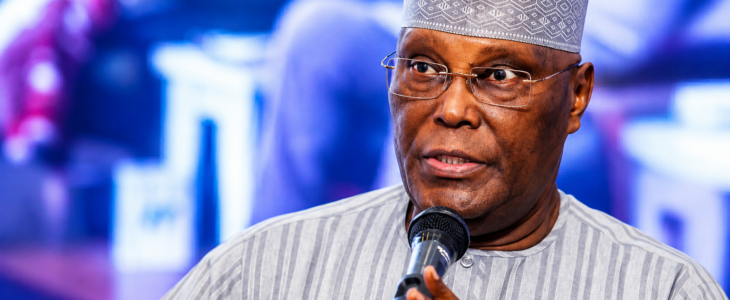
Former Vice President Atiku Abubakar has critcised President Bola Tinubu over alleged appropriation of N8.05 billion for mosques and church related projects in the 2026 budget.
In a statement by his Senior Special Assistant on Public Communication, Phrank Shaibu, Atiku expressed concern that while millions of Nigerians were grappling with crushing poverty, the Federal Government was earmarking N8.05 billion for religious related projects.
He stated that according to an analysis by the public accountability organisation, Tracka, about N1.91 billion had been allocated to church-related projects and N6.14 billion to mosque-related projects.
The 2027 presidential candidate of the African Democratic Congress (ADC), noted that while faith occupies a sacred place in national life, it must never become a sanctuary for opaque budgeting or questionable public expenditure.

According to him, “under the Nigerian law, religious bodies generally operate as Incorporated Trustees with distinct legal identities. If public funds are appropriated for projects involving such bodies, Nigerians have a right to know exactly which churches, which mosques and in which communities those projects will be executed.
“Unlike roads, schools, hospitals and other public infrastructure that are ordinarily identified by location and beneficiary, these allocations reportedly fail to identify many of the specific beneficiary churches and mosques.
“While some line items mention broad locations, the budget does not sufficiently disclose the identities of many beneficiary worship centres, making independent verification difficult and raising legitimate concerns about transparency and accountability.
“Though we tread with profound meticulousness in matters that relate to the Almighty, so as not to attract spiritual jabs from the overly sensitive faithful, it is a desecration of faith to commit public funds in God’s name, while withholding the information that would enable citizens to verify where their money is going. The government cannot invoke the sanctity of religion to evade the standards of openness demanded in the management of public resources.”
Atiku challenged the Tinubu administration to immediately publish the names of every beneficiary institution, every project location, every implementing agency, and the legal basis for the allocations, if the appropriations are genuine.
He stated that anything short of that would reinforce the perception that religion is allegedly being exploited as a convenient cover for diverting public resources.
“The Tinubu administration has crossed the moral red line by dragging the altar and the minbar into the marketplace of opaque budgeting. If these appropriations are genuine, the Presidency should immediately publish the names of every beneficiary institution, every project location, every implementing agency and the legal basis for the allocations. Anything less, will reinforce the growing perception that religion is being exploited as a convenient cover for diverting public resources.
“The Tinubu administration must resist the dangerous temptation to drag our priests, pastors, imams and other religious leaders into its budgeting racket. The altar and the minbar are sacred spaces for moral instruction and spiritual guidance, not convenient hiding places for questionable appropriations.
“The government must not seek to stain the integrity of our religious institutions or infect men and women of faith with the leprous fingers of fiscal filth. If there are genuine projects deserving public support, let them be openly identified, lawfully appropriated and transparently executed. The government must keep its leprous fingers of fiscal filth away from the altar and the minbar.
“God is not a laundering machine for public funds. ..
The Tinubu administration has no moral or legal licence to hide behind the altar, the minbar or the sacred robes of our priests and imams to mask questionable appropriations. If these projects are genuine, publish the names of every beneficiary institution, disclose every project location and execute every project in full public view. “
Reacting to the development, David Etim, Project Lead of Calabar and Gulf of Guinea Municipal and Trade Centre Ltd/Gte, described it as a misplaced priority, saying public funds should prioritise schools, hospitals over religious projects
He argued that while the government’s support for religion had become customary, scarce resources should instead address poverty, education and healthcare.
According to him, investing in schools and hospitals would improve millions of lives more than financing churches, mosques or pilgrimages.
“We have 140 million Nigerians living in multidimensional poverty. But God is not going to come down from heaven. God is going to use human beings to make the life of those other human beings better.
“If we are not impacting our fellow human beings, making the life of the least Nigerian to be better than what it is, or what it was yesterday and with progressively better on a daily basis, thereby translating to lifting people out of poverty, then really and truly, what God are we serving?
“Because man is God to man. God enables me to have capacity so that I can help the next guy behind me. And the government is at the top of that pyramid. Now, in building that church, if the government was to choose between building that church and building a school or a hospital, putting that N8.5 billion into a hospital and funding that hospital well, or into a school and funding that school well, and impacting a hundred thousand lives or a million lives or two million lives, I personally think that God will appreciate that more than building a church or a mosque, for that matter.
“So, in my opinion, it has happened and it has happened, but in my opinion, it shouldn’t have happened at all,” he explained.
Also reacting, the Alliance for Economic Research and Ethics (AERE) Ltd/Gte urged Nigerians to look beyond the controversy over the ₦8.05 billion allocation for churches and mosques in the 2026 budget, saying the country’s worsening fiscal imbalance poses a far greater threat to the economy.
In a statement, the group said while reports by ICIR and Tracka correctly showed that N6.14 billion was allocated for 52 mosques and N1.91 billion for seven churches, the spending accounts for only 0.0118 percent of the proposed N68.32 trillion budget.
It argued that removing the allocation would make little difference to the projected N31.45 trillion budget deficit, insisting that public attention should instead focus on the government’s growing dependence on borrowing and rising debt obligations.
According to AERE, the Federal Government plans to finance 46.1 percent of the 2026 budget through borrowing because projected revenues remain inadequate to meet spending needs.
The group also expressed concern that N15.8 trillion has been earmarked for debt servicing, describing it as a major drain on public finances. It noted that debt service accounts for about 23 percent of total expenditure and nearly 43 percent of expected revenue.
It further questioned the inclusion of religious projects in the budgets of ministries with no direct responsibility for such activities, including the Ministries of Agriculture, Labour and Marine and Blue Economy.
It said the practice undermines transparency, weakens accountability and makes it difficult for the public to monitor how government funds are spent.
The group called for greater emphasis on strengthening revenue generation, improving fiscal discipline, and ensuring that public spending is directed toward high-impact infrastructure and economic development projects.
It added that Nigeria’s long-term economic stability depends on addressing structural weaknesses in public finance rather than focusing solely on relatively small and symbolic budget allocations.
Credit: The Sun