
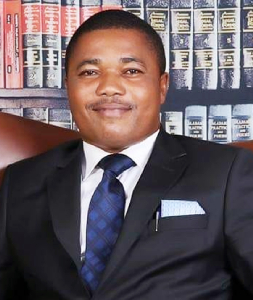
By Chukwudi Ebele
Human Rights Lawyer and Social Critic Sir Ifeanyichukwu Ejiofor Esq has bemoaned the escalating tide of genocide killings and alleged victims of jihadists terror.

In his article titled ‘THE ESCALATING TIDE OF GENOCIDAL ATROCITIES: MASS BURIAL OF 27 VICTIMS OF JIHADIST TERROR AS NIGERIA’S CONSCIENCE STANDS TRIAL’, Ejiofor warned that if the situation was not controlled now, it could lead to regrettably consequences, total collapse where more communities are plunged into irreversible devastation.
According to Ejiofor, Even as Coordinated Online Attacks Against the Catholic Bishops Following Their Candid Audience with the Presidency Intensify.

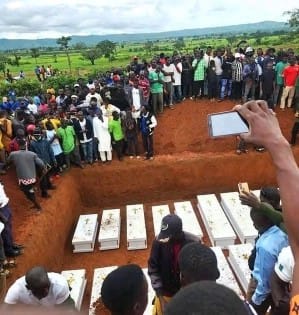
“A few days ago, Nigeria was confronted with yet another harrowing spectacle, one that should have shaken the conscience of every citizen and every institution entrusted with the sacred responsibility of preserving human life. It was neither a festive gathering nor the joyous celebration of a mass wedding often witnessed in our communities. Rather, it was a solemn and heart-rending requiem conducted by the Catholic Diocese of Kafanchan, where twenty-seven innocent Christians, reported victims of yet another brutal attack in Kaduna State, were committed to Mother Earth in a single mass burial.
Reports indicate that the attack culminating in these tragic burials occurred at about 11:00 p.m. on Sunday night when armed jihadist terrorist invaded Naridan, a predominantly farming border community between Kaduna State and Ganawuri in Riyom Local Government Area of Plateau State. At least thirty persons were killed, including women and children; homes were set ablaze, while several residents were abducted as families slept helplessly in the darkness.
Their only “crime” was existing in communities that have, for years, borne the crushing weight of relentless violence. They were fathers and mothers, children and youths, husbands and wives, farmers and artisans, ordinary Nigerians whose dreams, aspirations, and futures were violently extinguished. They were citizens no different from you or me, whose fundamental constitutional right to life was brutally denied by those who continue to unleash terror with alarming impunity.
The haunting image of twenty-seven coffins arranged in mournful silence is not merely a photograph; it is a profound indictment of a nation steadily becoming desensitized to recurring mass killings. It is a chilling reminder that beyond the political slogans and official assurances lies a tragic reality that refuses to disappear.
History teaches that every genocide begins with the normalization of repeated atrocities and the collective silence that follows them. Rwanda did not descend into catastrophe overnight. Bosnia’s darkest chapters were preceded by years of ignored warning signs. Across history, societies that failed to confront systematic violence at its formative stages ultimately paid an unimaginable price. Nigeria must resist travelling that perilous path.
One cannot behold those rows of coffins without arriving at the painful conclusion that Nigeria is engaged in a grievous security crisis. Whether one characterizes the violence as terrorism, insurgency, or coordinated criminality, the undeniable reality is that innocent lives continue to be lost on a scale that should provoke sustained national outrage. Yet, disturbingly, the urgency of this humanitarian tragedy increasingly appears overshadowed by the political calculations and permutations surrounding the 2027 general elections.
The news of these devastating killings briefly occupied newspaper headlines and social media timelines before being swallowed by the next cycle of political controversy. Such recurring national amnesia is both dangerous and tragic. A country that quickly forgets its dead inadvertently encourages the cycle that continues to produce them.
Equally disturbing is the reaction that followed the recent visit of the Catholic Bishops of Nigeria to the Presidency. Rather than receiving commendation for courageously conveying the painful realities confronting millions of Nigerians, several bishops became the subject of intense criticism and online bullying, some of which appeared coordinated, after honestly expressing the grave concerns of citizens over insecurity and worsening national conditions.
Religious leaders occupy a unique moral space in every democratic society. Their prophetic/pastoral responsibility has never been to flatter those in authority but to speak truth with courage, compassion, and fidelity to conscience. Throughout history, men and women of faith have often stood as the final moral compass when political institutions struggled to confront uncomfortable realities.
A government genuinely committed to solving national problems should welcome sincere criticism, particularly from respected institutions whose only interest is the preservation of human dignity and national stability. Honest counsel should never be mistaken for hostility. Constructive criticism remains one of democracy’s indispensable safeguards.
The time for measured but decisive action is now. The blood of innocent Nigerians should awaken our collective conscience, not merely our emotions. National security must once again become the foremost priority of the State. Every lawful resource, every constitutional mechanism, and every available intelligence capability must be deployed to halt this relentless cycle of violence before even more communities are plunged into irreversible devastation.
Nigeria owes her citizens not merely condolences after tragedy, but the unwavering protection that every sovereign nation is duty-bound to provide,”said Ejiofor.