
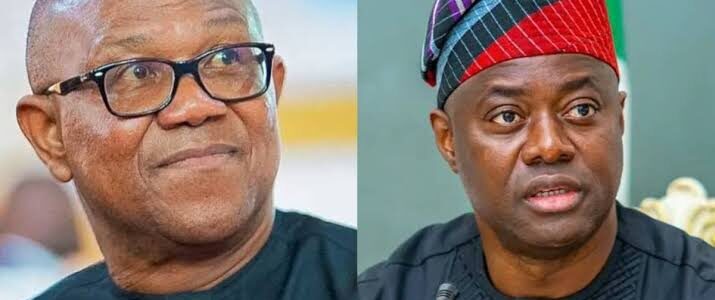
President Bola Tinubu has come under renewed criticism over his administration’s borrowing policy, with former Anambra State governor and presidential candidate of the Nigerian Democratic Congress (NDC), Peter Obi, Oyo State Governor and Allied Peoples Movement (APM) presidential candidate, Seyi Makinde, and the NDC demanding explanations for the country’s mounting debt obligations and the utilisation of funds borrowed since May 2023.
The fresh criticisms followed Tinubu’s request for National Assembly approval to borrow an additional $20.52 billion and €1.045 billion, amid concerns over Nigeria’s N166.79 trillion public debt, rising debt servicing obligations, high borrowing costs and the failure of increased government revenue to translate into affordable financing for businesses and manufacturers.
While Obi challenged the president to account for nearly $100 billion which he alleged the administration had borrowed and to personally explain his performance to Nigerians during the 2027 election campaigns, Makinde questioned the justification for additional external loans despite government claims of improved revenue collections and substantial foreign reserves.
The NDC, on its part, demanded a comprehensive, project-by-project account of previous borrowings, warning that Nigeria’s potential external debt exposure could rise to approximately $81.96 billion if the latest proposals and previously approved but undrawn facilities were fully accessed.

Speaking at a town hall meeting in Enugu yesterday, Obi insisted that Nigerians deserved to know what the Federal Government had accomplished with the money borrowed over the past three years, particularly at a time when the country was grappling with hunger, unemployment, insecurity and other economic difficulties.
“Our president must come and account for the three years he has been in office. He cannot stay in Abuja and expect us to vote for him. You must account for all the money you borrowed,” Obi said.
“He must come and tell us where our money is. We want to know what all the money he borrowed was used for.”
The former Anambra State governor also challenged Tinubu to spend at least 36 days campaigning across the country ahead of the 2027 presidential election, arguing that the president owed Nigerians a personal explanation of his administration’s performance.
According to him, Tinubu should not be allowed to avoid travelling across the country to seek votes after reportedly indicating that he might not be able to visit every part of Nigeria.
“Your president said he would not be able to campaign all over Nigeria. Please, do not listen to him. He must come and campaign all over Nigeria.
“Our president has travelled out of this country more than 350 times. Now, we are asking him to spend at least 36 days going round Nigeria and telling Nigerians what he has been doing for the past three years. He must go round Nigeria and tell us what he did with the nearly $100 billion he borrowed,” Obi said.
The figures cited by Obi were presented as his allegations, rather than independently established totals of funds actually borrowed or disbursed.
Obi said his presidential ambition was driven by the desire to build a country where citizens could prosper through hard work, merit and opportunity rather than personal connections, urging Nigerians to judge aspirants by their competence and capacity instead of ethnic or religious considerations.
“We want to build a Nigeria where a child of nobody can become somebody without knowing anybody,” he said.
“Do not vote for me because I am an Igbo man. Please, I am asking for your vote because I am the most qualified to be president of Nigeria.”
He challenged other presidential aspirants to travel across the country, engage directly with citizens and explain their plans for addressing Nigeria’s economic and security problems.
Outlining his priorities, Obi promised to unite the country, tackle insecurity, fight corruption, improve access to education, strengthen primary healthcare and revive industrial production through improved electricity supply.
He said his administration would not tolerate the abduction of schoolchildren without decisive intervention by the government.
“I will not be president while somebody kidnaps schoolchildren and takes them into the bush. If they go into the bush, I will be in the bush with them,” he said.
On corruption, Obi promised to declare a state of emergency, insisting that public resources must be deployed transparently for the benefit of Nigerians.
“People must stop stealing public money. Public money must be used for the public good. That is why I am making this commitment. We will be accountable and open. If we borrow money, you will know what the money is being borrowed for,” he said.
He also pledged to declare a state of emergency in education, expand access to schooling and ensure that every ward in the country had primary healthcare services.
On electricity, he reiterated his promise to generate, transmit and distribute at least 10,000 megawatts of power to support manufacturing and economic development.
“As I promised, we will generate, transmit and distribute at least 10,000 megawatts of electricity because we want our industries to work,” he stated.
Similarly, Makinde, speaking at the South-East Town Hall Meeting organised by the Makinde-Daura Presidential Campaign Organisation (MDPCO), questioned the administration’s continued reliance on external borrowing despite its claims of improved tax revenue and substantial foreign reserves.
“We are told that Nigeria has substantial foreign reserves and that the Nigerian Revenue Service has collected enough tax revenue, even surpassing its target for the year. Yet, despite these claims, the government still has to borrow money. How does that add up?” he asked.
The Oyo State governor argued that increased government revenue should ordinarily be accompanied by improvements in the availability of affordable, long-term financing for productive enterprises, particularly manufacturers whose operations require substantial investment and sustained access to credit.
Drawing from his private-sector experience, Makinde said the prevailing high interest rates and dependence on short-term bank facilities were major impediments to industrial expansion and job creation.
“I came from the private sector. I have been paying workers’ salaries since I was 29, and I am now 58. So, I understand what it means for an economy to expand. One indication of an expanding economy is the availability of long-term financing. Right now, bankers can tell you that what we have are mainly short-term credit facilities intended for trading.
“Yes, trading is an activity for which this zone is well known, but manufacturing is equally important. If you visit Nnewi or Onitsha, you will see that these cities are not just centres of trade; they also have manufacturing industries. You cannot expand manufacturing when businesses face interest rates of 25 per cent and cannot access long-term financing. These are two challenges we will address decisively,” he said.
Makinde promised that, if elected president, his administration would prioritise entrepreneurship, youth employment and policies that would enable businesses to expand and create sustainable jobs.
“We will tackle youth unemployment by encouraging entrepreneurship because entrepreneurs are the ones who can create sustainable jobs. That is exactly what we will do. We will create a conducive business environment across the country to enable businesses to thrive,” he stated.
The APM presidential candidate also called for greater sincerity and transparency in the management of the economy, saying Nigerians deserved accurate information about the country’s financial and social conditions.
Reacting to reports that Tinubu was travelling to Saudi Arabia for Umrah and would use the opportunity to pray for Nigeria, Makinde said prayers must be accompanied by honesty, accountability and responsible leadership.
“I was reading on social media last night and into this morning that our President is travelling to Saudi Arabia to pray for Nigeria. Well, prayers can also be answered here in Nigeria. Please, we will remain here, pray for our country and pray for our leaders because Nigeria belongs to all of us.
“As I always say, when the tide rises, all boats rise with it. If Nigeria moves in the right direction, we will all benefit. Our leaders should please pray for Nigeria, but they should also stop deceiving the people and tell Nigerians the true state of affairs. That way, as they pray, our prayers will not be in vain,” he said.
Turning to the 2027 general election, Makinde urged Nigerians to reject ethnic and religious divisions, stressing that the country’s economic and security challenges affected citizens irrespective of their backgrounds.
He disclosed that his campaign organisation had been discouraged from holding its South-East town hall meeting because of the political support enjoyed by Obi in the region, but insisted that every presidential aspirant deserved an opportunity to present proposals to Nigerians.
“When we were coming here, we were almost discouraged. People told us, ‘This is the zone of my friend and brother, His Excellency Peter Obi. The entire South-East is firmly behind him.’
“But we said that we would not be deterred. We would bring our message to the South-East and give the people an opportunity to hear what we have to offer.
“My message to you today is this: Please reject all forms of division along religious or ethnic lines. The challenges we face do not discriminate on the basis of religion or ethnicity,” he said.
Makinde explained that his Reset Nigeria Agenda rested on four pillars: resetting the economy, restructuring the security architecture, reforming the education system and resetting the socio-political space.
He said his campaign organisation had undertaken consultations across the six geopolitical zones to incorporate citizens’ expectations into its policy proposals, adding that the manifesto would be unveiled on November 4, 2026.
“Some people have been asking us, ‘Where is your manifesto? You have been criticising the current administration, but tell us what you intend to do.’
“Well, we have been travelling around the country. We have visited the North-East, North-West, North-Central, South-South and South-West, and we are now in the South-East. We are not like them. We do not simply manufacture policies out of thin air. We listen to our people, hear what they want to see, and incorporate their expectations into our agenda,” he said.
He added: “This is the final town hall meeting. Over the weekend, we will work around the clock with our team to finalise our manifesto, which will be unveiled on November 4, 2026. In that manifesto, you will find the issues you have raised with us and our proposed solutions to the challenges confronting our country.”
Makinde maintained that sincerity and accountability remained fundamental to resolving Nigeria’s economic and social problems.
“Of course, every country faces challenges. There is no doubt about that. However, I believe that 30 per cent of these challenges can be resolved simply by demonstrating sincerity. When we confront these problems with honesty and sincerity, 30 per cent of them will disappear on their own,” he stated.
Meanwhile, the NDC has raised concerns over the country’s mounting debt profile, demanding that the Federal Government provide a comprehensive account of the economic benefits of loans contracted since Tinubu assumed office in May 2023.
In a statement issued by the spokesperson of its National Presidential Campaign Council, Dr Chiogo Constance Ikokwu, the party said the latest borrowing request raised fundamental questions about the sustainability of Nigeria’s debt obligations and the government’s ability to translate external financing into measurable development outcomes.
According to the party, Nigeria’s external debt rose from $43.16 billion in June 2023 to $54.52 billion in June 2026, representing an increase of $11.36 billion or 26.3 per cent.
It added that total public debt climbed from ₦87.38 trillion to ₦166.79 trillion within the same period, an increase of approximately 90.9 per cent.
“Total public debt is worse. It climbed from ₦87.38 trillion to ₦166.79 trillion over the same period, a jump of about 90.9 per cent,” Ikokwu stated.
The party warned that adding the latest borrowing request to previously approved but undrawn financing could bring Nigeria’s potential external debt exposure to approximately $81.96 billion, although it clarified that the figure was an illustrative estimate rather than actual outstanding debt and assumed no overlap between the financing arrangements.
It demanded a detailed explanation of projects financed through previous loans, insisting that Nigerians deserved to know how the borrowings had improved infrastructure, electricity supply, healthcare and economic opportunities.
“Nigerians deserve to know precisely what these loans will deliver,” the party said.
It also questioned the justification for seeking additional loans when lawmakers had complained about inadequate releases of capital allocations to ministries, departments and agencies under previous budgets.
“If government revenues are rising, why does the need for borrowing remain so large?” the party queried.
The NDC consequently demanded that the Federal Government publish a project-by-project register of all external loans contracted since May 2023, indicating amounts borrowed and disbursed, repayment terms, project locations, implementation status and independently verified outcomes.
It also called for a comprehensive assessment of future debt servicing obligations and the risks posed by exchange rate fluctuations, urging the National Assembly to subject Tinubu’s latest borrowing request to rigorous scrutiny before granting approval.
The party maintained that it was not opposed to borrowing for development but insisted that loans must finance productive investments capable of generating measurable economic benefits.
“Borrowing can support national development, but only when investments deliver measurable benefits and repayment remains sustainable,” the statement said.
It added that the fundamental question was not simply how much Nigeria could borrow but “what Nigerians are getting in return.”
The criticisms come amid the Federal Government’s defence of its supplementary external borrowing proposal, which it maintains is intended to support investment in infrastructure, agriculture, healthcare, education, water resources, security and other sectors considered essential to economic growth.
The administration has argued that borrowing for productive investments should be assessed in relation to the development outcomes expected from the projects rather than treated solely as an increase in the country’s debt burden.
However, Obi, Makinde and the NDC insist that the government must demonstrate how previous borrowings have benefited Nigerians, explain the continued need for additional loans despite improved revenue collections and establish that future debt obligations will remain sustainable.
Credit: The Sun