
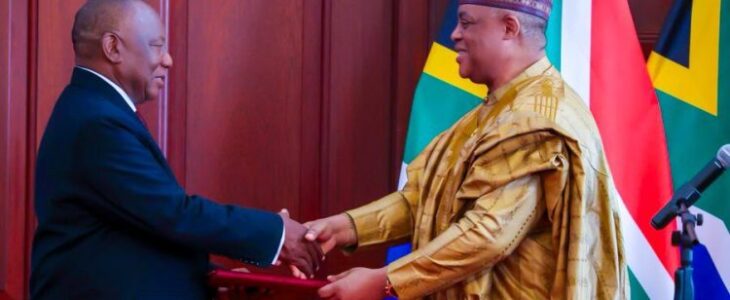
The diplomatic row involving Nigeria’s High Commissioner to South Africa, Femi Fani-Kayode, and the South African authorities has deepened, with Pretoria summoning the Nigerian envoy over his allegations that his presentation of letters of credence to President Cyril Ramaphosa was deliberately excluded from a live broadcast.
South Africa also expressed concern over Fani-Kayode’s subsequent remarks on social media, invoking the 1961 Vienna Convention on Diplomatic Relations and insisting that official communication with the host government must be conducted through established diplomatic channels.

Director-General of South Africa’s Department of International Relations and Cooperation (DIRCO), Zane Dangor, conveyed the government’s position during a meeting with Fani-Kayode yesterday, following the controversy that erupted after the Nigerian envoy presented his credentials alongside 14 other foreign diplomats last Friday.
In a statement made available to Daily Sun, DIRCO said Dangor expressed South Africa’s concern over developments following the ceremony and the Nigerian diplomat’s public comments, stressing the need to preserve the longstanding relationship between the two countries.

“The Director-General reaffirmed the importance of preserving the longstanding and historic bilateral relationship between South Africa and Nigeria, which is founded on mutual respect, friendship and cooperation,” the statement said.
The department disclosed that Dangor specifically drew Fani-Kayode’s attention to Article 41 of the Vienna Convention on Diplomatic Relations, which governs the conduct of diplomats in their host countries.
“Mr Dangor further recalled the provisions of Article 41 of the Vienna Convention on Diplomatic Relations (1961), which require diplomatic agents to conduct official business with the receiving State through the Ministry of Foreign Affairs.
“In this regard, it was emphasised that all official communication should be conducted through established diplomatic channels, including DIRCO,” the South African government stated.
The latest development followed a series of exchanges between Fani-Kayode, the South African Presidency and the South African Broadcasting Corporation (SABC) over the handling of the November 13 ceremony at the Sefako Makgatho Presidential Guest House in Pretoria.
Fani-Kayode, who presented his credentials alongside 14 other foreign envoys, alleged that his introduction and speech were deliberately excluded from the Presidency’s livestream, although the presentations of other diplomats were broadcast.
He claimed that the transmission was interrupted before his address and resumed after he had concluded his presentation to Ramaphosa.
The Nigerian envoy said he subsequently raised the matter with the South African President, who, according to him, intervened and directed officials to address the complaint.
However, Ramaphosa’s spokesperson, Vincent Magwenya, disputed aspects of Fani-Kayode’s account, explaining that the President had directed him to Sophie Mokoena, the SABC’s acting political and foreign editor, to resolve the broadcasting complaint.
Magwenya maintained that the President did not interfere with the broadcaster’s editorial operations.
The controversy took another turn when the Nigerian High Commission rejected Magwenya’s explanation and criticised his handling of the matter, widening what began as a disagreement over television coverage into a public exchange between the diplomatic mission and the South African Presidency.
The SABC subsequently defended its coverage, insisting that it operated as an independent public service broadcaster and that its editorial decisions were separate from the South African Presidency’s livestream arrangements.
In a statement issued on Sunday, the broadcaster said it covered the ceremony through its SABC News LIVE channel on SABC+ and also showed Fani-Kayode’s arrival on its television platform.
It disclosed that footage of the Nigerian envoy interacting with Ramaphosa had been published on its official social media account.
The broadcaster also expressed regret that Fani-Kayode declined an interview invitation following the ceremony, saying it remained willing to engage with him and the Nigerian High Commission.
However, the SABC’s explanation did not directly resolve the envoy’s complaint about the omission of his speech from the Presidency’s livestream.
The South African Presidency later released a recording containing Fani-Kayode’s address, although the development did not immediately end the disagreement.
Reports of the original broadcast indicated that the transmission appeared to develop a technical problem during the presentation by the French ambassador, Antoine Michon, who spoke immediately before Fani-Kayode. The available reports did not establish that the interruption was deliberate.
The diplomatic disagreement comes against the background of longstanding relations between Nigeria and South Africa, two major African economies whose ties have periodically been strained by attacks on foreign nationals, immigration-related tensions and disagreements over the treatment of Nigerian citizens.
Concerns over the safety of Nigerians in South Africa have remained a recurring issue in bilateral relations, with Nigerian authorities and lawmakers previously raising objections to attacks and harassment involving their citizens.
The latest dispute has therefore placed renewed attention on the conduct of diplomatic engagement between Abuja and Pretoria, particularly the procedures governing communication between foreign envoys and their host governments.
Despite the controversy, DIRCO maintained that South Africa remained committed to strengthening its strategic partnership with Nigeria and sustaining constructive diplomatic engagement in the spirit of African solidarity and mutual respect.
Credit: The Sun