
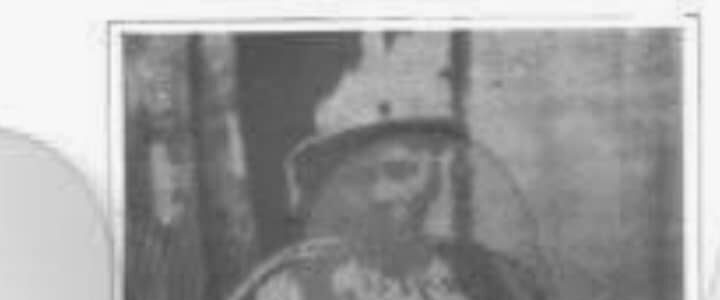
From Ijeoma John, Nnewi
On January 3, 2026, the ancient town of Nnewi will once again turn its gaze to history as it marks the 80th posthumous anniversary of Chief Nwosu EzeOdumegwu, Obi EzeEnwe and the last bearer of the revered Onuo Orah of Nnewi title. Eight decades after his passing in 1945, his name still echoes across Igboland—spoken with awe, respect and an enduring sense of legacy.

According to Mr.Ikenna Nwosu, the Chairman of the family, he said EzeOdumegwu was born in 1840 into the royal lineage of Ekwegbalu (Eze Enwe), a grandson of Eze Oguine, Obi of Nnewi, Chief Nwosu EzeOdumegwu was forged at the intersection of power, tradition and destiny. His life spanned one of the most transformative periods in Igbo history—from pre-colonial warfare and territorial expansion to the arrival of British colonial rule and Christian missionaries.
“Chief EzeOdumegwu’s ancestry placed him firmly within the ruling elite of Nnewi. His father, Eze Onyejemeni (Okereke), and his grandfather, Eze Enwe, were themselves warriors and custodians of the Onuo Orah legacy—an honorific meaning “Conqueror of Nations.” The title symbolized the highest military authority in Nnewi, reserved only for men of proven bravery, strategy and service to the town.

“His mother, Mgboli Nka’gba, a noblewoman from Amakwa, Ozubulu, was renowned for her strength, beauty and influence. In an era when children were often identified through their mothers, he was widely known in his early years as Nwosu Mgboli—a name that would later command fear and reverence far beyond Nnewi” he stated.
Ikenna Nwosu disclosed that he ascended the throne of Obi EzeEnwe after the death of his father, Nwosu underwent the Igbu-Ichi rites and took the title EzeOdumegwu. He would go on to distinguish himself as perhaps the most formidable of all Onuo Orah title holders.
“On behalf of the Igwe of Nnewi, he led and prosecuted wars against several neighboring communities, including Ubaru, Awka-Etiti, Amichi and Utuh, securing territories and redefining boundaries. His campaigns expanded Nnewi’s influence and safeguarded its people at a time when land meant survival, wealth and power.
“Installed formally as Onuo Orah of Nnewi, he bore the ancient insignia of the office: the Ikpon’asato—an iron armlet with eight rattles—the six-foot iron staff known as obo, and the traditional sword, obejili. He was the fifth and final bearer of this exalted title, following Igwe Eze Agha, Eze Oguine, Eze Enwe and Eze Ejemeni” he further disclosed.
He noted that Chief EzeOdumegwu’s wealth was legendary. Landed property, the primary measure of affluence in his time, flowed into his domain through conquest, diplomacy and alliances. His fame inspired a popular Igbo saying: “O na-abu onye akochighi mbubo ozaba EzeOdumegwu?”—a rhetorical question underscoring the impossibility of ignoring his power.
“His marriages, many of which carried diplomatic significance, linked him to families across Ihiala, Ahoada, Arochukwu, Ohafia, Arondizuogu, Mgbakwu, Oraeri and beyond. Some unions followed acts of statesmanship, such as his role in securing the release of the Obi of Uruagu from colonial imprisonment.
“Despite his fearsome reputation, family accounts describe him as a gentle father and a generous patriarch—one who fed both household and strangers alike within his Obi” he remarked.
Ikenna revealed when British forces led by Major Moorhouse arrived in Nnewi on December 24, 1904, fear gripped the town. Chief EzeOdumegwu’s diplomacy averted disaster by surrendering a deserter sought by the British and organizing a peaceful reception, he prevented the destruction of Nnewi.
“Impressed, Major Moorhouse offered to install him as king of Nnewi—a proposal he declined out of loyalty to tradition, insisting that the throne belonged to his younger cousin, Chief Orizu EzeUgbonyemba. It was a defining act of restraint and statesmanship.
“He later played a central role in the Isujiegbe—the surrender of arms to the British—preventing bloodshed across Nnewi and neighboring towns. Appointed a First Class Chief, he presided over customary courts and became a pillar of colonial-era administration, wielding authority matched by very few of his contemporaries” he further revealed.
He said Chief EzeOdumegwu welcomed Christian missionaries with open arms. The Church Missionary Society (CMS) arrived in 1903, followed by the Roman Catholic Mission in 1904. He provided land, accommodation and protection, enabling the establishment of institutions that still stand today—St. Thomas Anglican Church, St. Peter Claver’s, Otolo, and later St. John Cross, Uruagu.
“In his final years, he embraced Christianity fully, receiving baptism into the Catholic faith shortly before his death in 1945. Yet, he remained deeply rooted in Igbo tradition—a rare balance that defined his life” he noted.
Ikenna Nwosu finally revealed that Chief Nwosu EzeOdumegwu died in 1945, leaving behind a lineage and legacy that continue to shape Nnewi. In 1983, a public memorial was held in his honor, marked by the erection of a statue at the historic site where the 1851 treaty with the Royal Niger Company was signed.
“Eighty years after his passing, his descendants and the wider Nnewi community gather once again—not merely to remember a man, but to celebrate a legacy of courage, restraint, generosity and vision.
“As Nnewi marks this 80th Memorial Celebration, Chief Nwosu EzeOdumegwu stands tall in history: a warrior who loved peace, a traditionalist who welcomed change, and a leader whose silence, as many recall, spoke louder than thunder” he reaffirmed.
Chief ( Barr.) Nnabuike Nwosu.
December 23, 2025 at 3:17 pmEzeodumegwu’s pedigree as described is next to none. I cannot say more.
CEU
December 25, 2025 at 2:07 pmThe author should include “Ọmụkwe” as the maternal kindred of EzeỌdụmegwu. Mgboli, her mother, was the daughter of Nkaagba, who was sired by Ọmụkwe – the Ọbi of Ọzụbụlụ at the time. Glad to read EzeỌdụmegwu’s mother was my great aunt. I come from Nkaagba royal family, Amakwa, Ọzụbụlụ.
Chief ,( Barr. ) Nnabuike Nwosu.
December 25, 2025 at 8:44 pmI am at home with the write-up. However, it is pathologically inexectitude to say the Ezeodumegwu fought wars on behalf of Igwe Nnewi. If it was so, the Igwe Nnewi would have been an Onou-ora. Why wasn’t he?
Afam Karl
December 29, 2025 at 7:42 amI expected the writer to have included the name of son Chief B.C. Nwosu. Dike Ana Anagbalu izu.
However, the story is not different from what I heard from Dike Ana Anagbalu izu himself during his life time.