
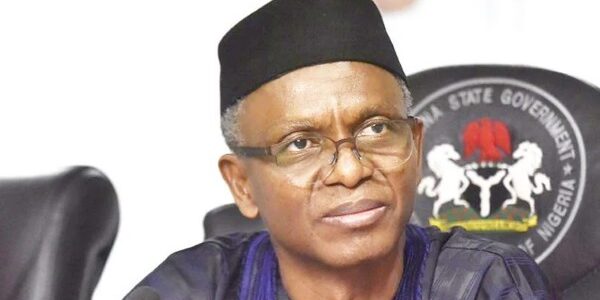
ICPC has faced a stream of criticisms since its controversial release of former Governor El-Rufai from custody on Friday snubbing a court order remanding him pending the hearing of his bail application.
Some lawyers have condemned the Independent Corrupt Practices and Other Related Offences Commission (ICPC) for the release of former Kaduna State Governor Nasir El-Rufai in disregard of the court order remanding him in its custody.
PREMIUM TIMES reported how ICPC released Mr El-Rufai on Friday for him to mourn his mother, who passed away on Friday, and be part of the burial rites.

On 24 March, the Federal High Court in Kaduna ordered Mr El-Rufai’s remand in ICPC custody, where he was already detained for over a month based on another court other.
The latest remand order on 24 March followed the arraignment of the former governor before the court on 10 corruption charges.

The ICPC arraigned him alongside Joel Adoga.
Both defendants pleaded not guilty to the charges.
Following their pleas, the trial judge, Ridwan Aikawa, ordered that they be remanded in ICPC custody pending the hearing of Mr El-Rufai’s bail application scheduled for Tuesday, 31 March.
Despite the subsisting order, the ICPC released the former governor on Friday without recourse to the court that ordered his remand.
His son, Bashir El-Rufai, first announced the development on X late Friday.
Sources at the ICPC confirmed to PREMIUM TIMES on Saturday that the former governor was released on Friday following his mother’s death.
“He was released on compassionate grounds to enable him to be part of the burial rites of his mother,” a source who had no authorisation to speak to journalists on the matter said.
PREMIUM TIMES reported earlier on Saturday how senior lawyer Femi Falana, human rights lawyer Inibehe Effiong and veteran journalist Richard Akinola criticised the the release of Mr El-Rufai in disobedience to the court order remanding him in custody.
More condemnations
More lawyers faulted the release in separate interviews with this newspaper on Saturday.
A lawyer, Liborous Oshoma, questioned the legality of the release, noting that administrative bail does not apply once a court has taken jurisdiction.
“Once a court orders that a suspect be remanded, administrative bail is no longer applicable. The authority to grant bail rests solely with the court,” he said on a phone call with PREMIUM TIMES.
“In such circumstances, any application must be made formally before the court. Granting bail on compassionate grounds after a remand order amounts to going against the court’s directive.”
Another human rights lawyer, Hamza Dantani, said the ICPC lacked the authority to grant bail after arraignment without court approval.
“Legally, once a defendant has been arraigned, the authority to grant bail rests solely with the court,” he said.
“In this instance, the court adjourned for a bail ruling on 31 March 2026. At that point, the prosecuting agency no longer has the authority to grant bail on any grounds unless it obtains the court’s approval.”
He added that any such request must be formally filed.
“Such an application cannot be made informally. It must be in writing and properly filed before the court,” he said.
Mr Dantani warned that the situation raises concerns about due process and institutional accountability.
“It raises concerns about due process and may affect confidence in both the judiciary and law enforcement agencies,” he said.
Yomi Adesanya, also a lawyer, criticised the release, describing it as a disregard for the judiciary.
“The release of El-Rufai without an order of court, while a bail application is pending, shows clearly how institutions no longer respect the rule of law,” he said.
He argued that the development could undermine public confidence in the justice system and warned against what he described as the appropriation of judicial powers.
Reacting to the news of the former governor’s release in a social media post on Saturday, Inibehe Effiong said ICPC has questions to answer.
Hafsat Usman, principal partner at Hafsat Usman and Co, said the action raises procedural concerns.
“My view is that since El-Rufai was remanded in ICPC custody by a competent court order, typically, an application would be needed to vary the order to allow him to attend the funeral. ICPC releasing him without a court order might be seen as inconsistent with the court’s directive.
“In Nigerian law, when a court orders detention, the agency (ICPC) usually needs to apply to the court for variation or temporary release. El-Rufai’s release without a court order could raise questions about procedural propriety,” she said.
However, human rights lawyer Tope Temokun offered a different perspective, saying agencies may exercise limited discretion where bail applications have not been determined.
“If a bail application has not yet been heard, the agency may exercise discretion regarding temporary release,” he said, adding that such discretion must be exercised carefully and within legal limits.
In a post on his Facebook page on Saturday, Deji Adeyanju described the decision as compassionate but stressed the need for judicial backing.
“The decision to grant Mallam Nasir El-Rufai temporary release from Independent Corrupt Practices Commission custody to attend his mother’s burial is both humane and commendable but must be backed by a court decision/order since he was remanded in custody on the order of the court.
“The decision to allow El-Rufai to attend his mother’s funeral reflects a necessary balance between the demands of justice and respect for fundamental human dignity. Bail, whether administrative or judicial, should not be misconstrued as an escape from accountability, but rather as a lawful and compassionate accommodation in deserving circumstances.
“This action by the authorities is a welcome demonstration of empathy while upholding the rule of law,” he stated.
But Mr Falana, who plainly described the release as illegal and warned against undermining the rule of law in PREMIUM TIMES’ previous publication, said the only way the ICPC could have legitimately released the former governor from custody was to rush back to the court with an application
“Nigerian authorities must learn to operate under the Rule of Law. There are ordinary people in custody who have lost both parents. Why are they never released in this manner to participate in the burial rites of their loved ones?” Mr Falana told PREMIUM TIMES on Saturday.
He said the appropriate thing to do “is to rush an application to the court seeking his release to enable him to participate in the burial rites of his mother. The prosecution and the defence could exchange processes electronically. The application could then be filed on Monday, accompanied by an affidavit of urgency so that it could be held the same day.”
Background
The ICPC arraigned Mr El-Rufai alongside Joel Adoga on 10 charges of corruption on 24 March.
In the charges filed on 18 March, the ICPC accused Mr El-Rufai of fraudulently taking inflated severance pay of about N289.8 million at the end of each of his two terms in office, instead of N20 million that he was legitimately entitled to on each occasion.
The anti-graft agency alleged that Mr El-Rufai received the first N289.8 million in September 2020 after completing his first term in office in May 2019, and the second N289.8 million in January 2023, months before the end of his second term in May 2023.
The payments totalled N579.7 million, instead of about N40 million he was entitled to for the two terms.
The commission added that each of the payments “represents 300% of your annual basic salary which you reasonably ought to have known that such fund formed part of the proceeds of an unlawful act, to wit: corruption.”
It said the offences were contrary to Section 18(2)(d) and punishable under Section 18(3) of the Money Laundering (Prevention and Prohibition) Act, 2022.
In the other eight counts, the ICPC accused Mr El-Rufai of receiving deposits of alleged proceeds of corruption and fraud totalling $817,900 in tranches in his Guaranty Trust Bank (GTB) domiciliary account while serving as governor of Kaduna State.
The commission said he received the deposits in tranches ranging from $4,000 to $320,800 between 2016 and March 2023. His co-defendant, Mr Adoga, appeared as a defendant in only one of the 10 counts but was named in another count as one of the persons who deposited money into Mr El-Rufai’s domiciliary account.
Both defendants pleaded not guilty to the charges.
The ICPC rearrested Mr El-Rufai on 18 February after the Economic and Financial Crimes Commission (EFCC) released him following two days of detention over corruption allegations.
Mr El-Rufai has described his prosecution as political persecution, citing fallout with President Bola Tinubu after his failed nomination to serve as minister in the president’s cabinet.
He also described his prolonged detention by the ICPC as illegal in a N1 billion fundamental rights enforcement suit he filed after ICPC agents searched his house on 19 February.
However, the ICPC countered the suit in its filing before the Federal High Court in Abuja, stating that both his detention and the search of his residence were based on court orders.
Credit: Premium Times