
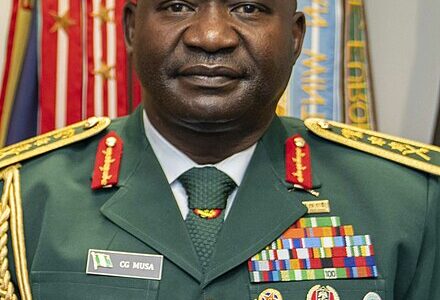
General Christopher Gwabi Musa (rtd.) arrived on the floor of the Senate today not as a man in search of validation, but as a soldier summoned by duty. The stakes were clear, the moment unmistakable: Nigeria stands at an inflection point where security is no longer an abstract policy debate but a lived national emergency. And in such moments, nations do not indulge in political theatre; they reach for competence, clarity, and command.
It is this logic—cold, pragmatic, and historically defensible—that underpinned Senator Mohammed Sani Musa’s insistence that the former Defence Chief should “take a bow and go.” Far from being an abdication of parliamentary scrutiny, the move represented a rare triumph of strategic thinking over procedural indulgence.

Senator Musa’s argument was disarmingly simple: you do not interrogate a battlefield General under the klieg lights of national television. Not when the very questions being asked dance dangerously close to operational intelligence. Not when open-air questioning risks revealing what adversaries should never know. And certainly not when the nominee in question has already briefed the legislature—multiple times—in classified sessions.
In the Senator’s words, the line of questioning had veered into “security and tactical questions,” the type responsible nations do not debate for the benefit of insurgents scrolling social media in Sambisa or bandit chieftains watching from Zamfara’s forests. On this, Senator Musa was right.

Across the world, serious nations treat defence portfolios with exceptional discretion. In the United States, a nominee for Secretary of Defense undergoes public hearings, but the sensitive grilling happens behind closed doors in secure, no-camera rooms deep inside Capitol Hill. In Israel, military commanders transitioning into ministerial roles are often spared performative questioning, with the Knesset focusing on strategic alignment rather than tactical theatrics. In the United Kingdom, top defence appointments go through National Security Vetting—almost entirely in secrecy. France, too, vets defence ministers using a heavily classified process.
No functioning democracy wastes a General’s operational wisdom on a televised Q&A whose only winners are criminals hungry for state weaknesses. By these standards, Senator Musa’s stance did not break norms—it aligned Nigeria with best global practice.
Critics have argued that the Ministry of Defence is “policy-driven” and therefore fair game for elaborate questioning. But this misses the point. A “policy-driven” Defence Ministry is only as effective as the man who understands how policy plays out on the battlefield. And Musa does—deeply. This is not a man who needs a lecture on bureaucracy. This is a man who has buried officers, led men into impossible terrain, and borne the moral weight of national defence. His competence is not theoretical; it is lived.
So when some Senators demanded elaborate explanations on operational frameworks, the exercise risked degenerating into a talk-show—one that Nigeria, currently engulfed by insecurity, cannot afford. Senator Musa captured the absurdity perfectly: “You are asking a war General how to run a ministry that is largely policy-driven.” It is akin to asking a firefighter to explain the chemical composition of water while the inferno rages behind him.
Nigeria’s security architecture is in the middle of a generational crisis. From the bandit corridors of the North-West to the terror cells of the North-East, from communal clashes in the Middle Belt to kidnapping highways in the South, the nation is fighting a multi-front war. And in war, nations act. When the house is on fire, as Senator Musa implied, you do not ask for the pH level of the water—you pour the water. You pick the man who can carry the hose, not the man who can quote its manufacturing manual. General Musa is that man.
“Bow and go” has been caricatured as a procedural shortcut. But not today. Today, it was a recognition that: the nominee has already faced senators in multiple classified briefings; the real questions cannot be asked on national TV; the crisis demands urgency over ceremony; and public interrogation of tactical details is a gift to the nation’s enemies. Senator Musa understood the moment required focus, not fanfare; execution, not exhibition.
His motion sparked murmurs—even disagreements among lawmakers—but leadership is not measured by unanimity. It is measured by clarity in crisis. And clarity was firmly on his side.
General Christopher Musa does not need applause; he needs a mandate. He does not need television time; he needs operational room. He does not need rhetorical questioning; he needs authority. Nigeria’s security challenges will not be solved in the chambers of televised hearings. They will be solved by decisive actions coordinated by professionals who know what war truly is.
Senator Sani Musa saw this. He argued it. He defended it. And he was right.
At a time like this, Nigeria does not need a spectacle. It needs solutions. It does not need an audition. It needs action. It does not need more questions. It needs competence.
And so, the call echoes: “General Musa, go—go and get the job done.”
For when a nation is on fire, history remembers those who poured the water, not those who asked what it tasted like.
Credit: Leadership