
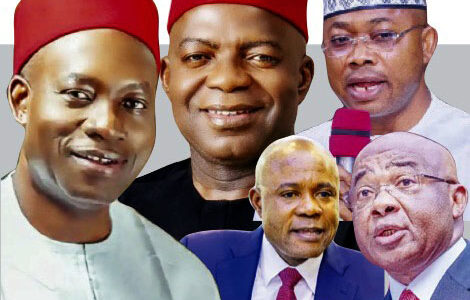
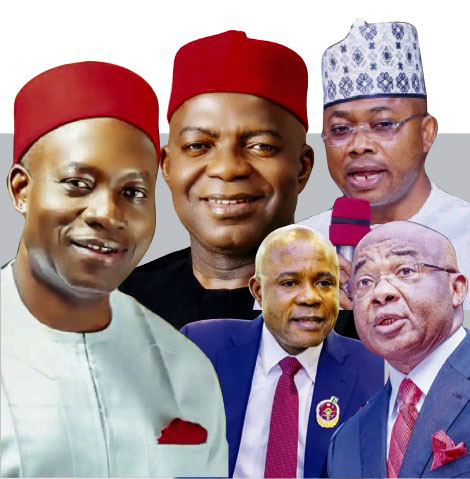
Controversy is raging over an alleged strategic move by parties controlling states to limit the visibility of the opposition as campaigns commence in full swing, through the imposition of exorbitant billboard levies on candidates and their political parties.
Such levies, stakeholders argue, constitute a clear violation of equal opportunity and fair play in a democratic election. Abia, Enugu, Kogi, Anambra and Imo states are among those toeing this path, a development that has sparked widespread outrage among opposition parties.
In Abia State, for instance, the State Structure for Signage and Advertisement Agency (ABSSAA) in late July announced that campaign advertisement for the 2027 general election would cost presidential candidates N200 million to display materials in approved advertising spaces across the state. Governorship candidates are to pay N150 million, senatorial candidates N100 million, House of Representatives candidates N50 million, and House of Assembly candidates N20 million. Beyond Abia, several other states controlled by various ruling parties have adopted similar regulatory structures that drastically raise the cost of political entry.
- Home
- National
- Columns
- Business
- China News
- Politics & Power
- Opinion
- Entertainment
- The Sun TV
- Sporting Sun
- The Sun Foundation
2027: States plot to silence opposition with N7.4 billion billboard levies
20 September 2026 12:25 am WAT
By Omoniyi Salaudeen, Okey Sampson, Umuahia, Jude Chinedu, Enugu, George Onyejiuwa, Owerri
Controversy is raging over an alleged strategic move by parties controlling states to limit the visibility of the opposition as campaigns commence in full swing, through the imposition of exorbitant billboard levies on candidates and their political parties.Lipocarnit1/2 Cup Of This (Before Bed) Will Melt Your Belly Fat Like CrazySafe! No Starvation and Physical Effort!Learn more
Such levies, stakeholders argue, constitute a clear violation of equal opportunity and fair play in a democratic election. Abia, Enugu, Kogi, Anambra and Imo states are among those toeing this path, a development that has sparked widespread outrage among opposition parties.
In Abia State, for instance, the State Structure for Signage and Advertisement Agency (ABSSAA) in late July announced that campaign advertisement for the 2027 general election would cost presidential candidates N200 million to display materials in approved advertising spaces across the state. Governorship candidates are to pay N150 million, senatorial candidates N100 million, House of Representatives candidates N50 million, and House of Assembly candidates N20 million. Beyond Abia, several other states controlled by various ruling parties have adopted similar regulatory structures that drastically raise the cost of political entry.
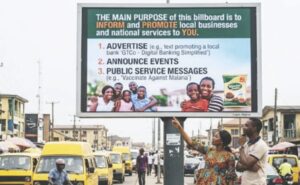
Stakeholders have described the fee regime as not only outrageous but as a calculated attempt to commercialise the democratic process and erect an uneven playing field long before the first ballot is cast.
Concerns raised by stakeholders
Opposition parties argue that incumbents are leveraging state signage agencies to financially squeeze rivals out of public spaces while using state resources to absorb their own costs. They contend that the levies conflict with Electoral Act spending caps.
Section 92 of the Electoral Act 2026 pegs campaign expenditure at N10 billion for a presidential candidate, while a governorship candidate is limited to N3bn. For the National Assembly, the ceiling is N500m for a senatorial candidate and N250m for a House of Representatives candidate.
What this means is that if all 36 states and the FCT replicated Abia’s N200 million charge, a presidential candidate would need N7.4 billion for billboard permits alone in state capitals, leaving only N2.6 billion of a N10bn hypothetical ceiling for logistics and other expenses. Paying N50 million to N200 million in a single state consumes a massive chunk of the total nationwide limit before factoring in rallies, logistics or media buys.
In states like Kogi, where regulations extend to branded T-shirts, caps and private vehicles, critics say the policies cross from regulating commercial outdoor media into infringing on individual freedom of expression.
While state governments maintain that these fees are non-discriminatory revenue measures designed to maintain urban aesthetics and curb political clutter, legal challenges and political pushback continue to grow. States argue that signage permits are administrative fees, not direct election expenses, and fall under municipal revenue generation.
Opponents, however, contend that prohibitive pricing violates Sections 39 (Freedom of Expression) and 40 (Freedom of Association) of the 1999 Constitution (as amended). Denying outdoor advertising on financial grounds, they argue, creates a discriminatory advantage for incumbent parties.
Opposition cries foul
In Enugu State, opposition parties and their candidates sharply rejected the N150 million signage and advertising fee imposed by the Enugu State Structure for Signage and Advertisement Agency (ENSSAA) ahead of the 2027 general elections. While the ruling All Progressives Congress (APC) defended the fee, insisting that all political parties were being treated equally, opposition parties described it as excessive and capable of restricting political participation.
The controversy followed the announcement by ENSSAA that political parties and candidates would be required to obtain a N150 million advertising permit before deploying outdoor campaign materials, including banners, branded vehicles, handbills, T-shirts, rallies and street campaigns.
The Secretary of the Nigerian Democratic Congress (NDC) in Enugu, Dr. Chukwuebuka Okafor, said the controversy should be viewed beyond party politics. According to him, the Inter-Party Advisory Council (IPAC) should intervene if it was serious about protecting the political space. “This issue is a national issue that should be looked into and resolved by IPAC if they are serious. It is not specifically for Enugu, and it is not a party thing,” Okafor said.
The PDP governorship candidate in Enugu, Chief Uche Nnaji, rejected the policy, describing it as “very heinous and anti-democratic”. Speaking through his campaign spokesman, Chief Chukwunweike Okeke, he alleged that the policy was designed to make it difficult for opposition parties to market their candidates. “It is a very heinous and anti-democratic stance for a democratic government in Enugu State to take. Trying to bring in oppression is very appalling, very reprehensible,” Okeke said.”
“For him to have used Enugu State Signage Agency to slam a fee of N150 million, which was not even clarified whether it was for the party or for candidates is anti-democratic. They did not say if the money is to be paid by the party or by the candidate. But our party has gone ahead to challenge that at the Federal High Court, Abuja. We are not allowing it to stay because freedom of expression and freedom of opinion is a critical tenet of a democratic government,” he stated.
However, the APC Publicity Secretary in Enugu, Chief Uchenna Obute, said there was nothing wrong with political parties paying the prescribed fee, stressing that the ruling party was also complying. “The political parties should pay the signage fee. We as APC are paying already. It is not wrong. The allegation that the intention of government is to shrink the political space is not true. That allegation is baseless.
“Government is not stopping any political party from campaigning or pasting billboards. What the government is saying is that if you want to do it, you have to pay. I don’t see anything wrong about it,” Obute said.
Although the Imo State off-season governorship poll holds in November, candidates for the State Assembly, House of Representatives and Senate who want visibility must obtain permit and approval from the Imo State Signage and Advertisement Agency (IMSAA), the sole approving authority. According to Sunday Sun findings, the IMSAA has different approval rates for elective positions. For senatorial candidates, a mandatory fee of N5 million is payable into the state’s TSA account. The candidate will also pay an application fee of N250,000 and site inspection fee of N500,000 directly to the agency before erecting billboards.
Similarly, House of Representatives candidates will pay N3 million to the TSA, plus N250,000 application fee and inspection fees to IMSAA. For State House of Assembly candidates, they must pay N1.5 million into the TSA and N200,000 to IMSAA as application and inspection charges.
Mr. Charles Okafor Nkenna, Media Coordinator of Action People’s Party (APP) for Ideato Federal Constituency, said: “We have to comply with the charges even though it is on the high side. The charges were contained in the letter written to the party and we have to comply so that we can legally erect our campaign billboards.
“The State Publicity Secretary of the African Democratic Congress (ADC), Chief MacDonald Amadi, said the rates are extremely high. “You see, Africans don’t know the essence of democracy and they see politics as a do-or-die affair. With the exorbitant rates which the Imo State Government through IMSAA imposed, which ordinarily should be the cheapest means for candidates to pass their messages to the electorate, is to make democracy more expensive,” he said.
In Abia, the opposition rejected outright the new billboard permit fees announced by ABSSAA, describing it as a draconian assault on political participation.
The acting State Chairman of the African Democratic Congress (ADC), Kalu Kalu Agu, said the new fees contravened the Electoral Act, especially campaign fund limits and fair play provisions. The Peoples Democratic Party (PDP) described the policy as an outrageous commercialisation of the democratic space. A statement by its Publicity Secretary, Jude Udeachara, said: “What ABSSAA did was not regulation, but political extortion dressed in administrative language aimed at silencing political opponents.”
“The imposition of these prohibitive charges raises grave questions about the Otti administration’s understanding of the campaign finance framework established by the Electoral Act.”
The All Progressives Congress (APC) described the policy as oppressive and unlawful. Its Publicity Secretary, Uche Aguoru, said: “This oppressive policy is unlawful, unconscionable and represents one of the most brazen attacks on democracy in the history of our state. It is a desperate, fear-driven attempt by the Labour Party administration to erect financial hurdles against political opponents. “The party called on INEC to take notice and demanded immediate withdrawal of the charges.
However, justifying the new regime fees, the Director in charge of ABSSAA, Okpara Chinedum John, said the agency’s activities go beyond revenue generation to promotion of the good image of Abia State in collaboration with relevant MDAs. He vowed that the agency would dismantle or revoke any campaign billboard that fails to comply.
Implications for 2027
Beyond the immediate outrage, the resort to exorbitant signage fees portends a dangerous monetisation of the democratic space that could fundamentally distort the 2027 general elections if left unchecked. When the cost of visibility becomes prohibitive, elections risk being decided not by the quality of ideas but by the financial muscle to purchase public space. This inevitably shrinks the political arena to a contest of the highest bidders, alienates grassroots movements, and discourages credible but less-endowed candidates from participating.
States rely on their constitutional powers over land administration under the Land Use Act and physical planning under the Residual Legislative List. They argue that state agencies have the authority to control visual pollution and regulate outdoor advertising.
Critics counter this with Section 95 of the Electoral Act, which mandates that state apparatuses, including public media and state-owned infrastructure, must not be used to the advantage or disadvantage of any political party or candidate. They argue that state signage agencies are being used as proxies to circumvent this provision.
Though they admit that state agencies have the authority to control visual pollution, the stakeholders maintain that the outrageous levies constitute a violation of equal opportunity and fair play.
However, legal experts warn that allowing states to hide under municipal revenue generation to impose campaign levies creates a loophole that could be exploited to circumvent national electoral safeguards. If signage agencies can charge N200 million today, nothing stops other state-controlled institutions – markets, motor parks, and town halls – from imposing similar fees tomorrow for access to voters.
To avert this, stakeholders are calling for urgent intervention. The Independent National Electoral Commission (INEC) has been urged to issue clear guidelines delineating administrative fees from campaign expenses, while the National Assembly should amend the Electoral Act to explicitly cap state levies on political advertising. The courts must also decisively interpret the intersection between Section 95 of the Electoral Act and states’ residual powers over outdoor advertising.
Ultimately, democracy thrives on equal opportunity for all contestants to be seen and heard. Regulating billboards to preserve aesthetics is legitimate; weaponising them to price opponents out of sight is not. As campaigns gather momentum, how this controversy is resolved will determine whether the 2027 elections are remembered for fair competition or for the highest billboard bidder.
Credit: The Sun