
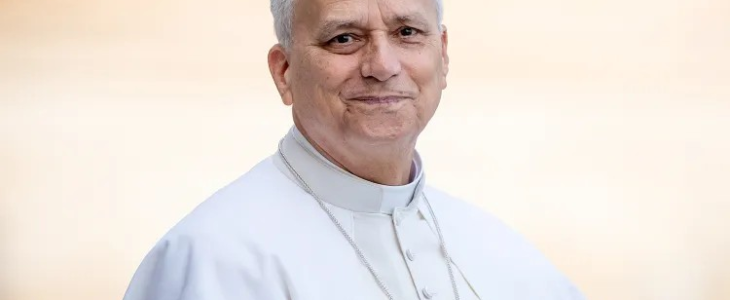
A revealing new book about Pope Leo hit the shelves shortly before the pontiff was diagnosed with cancer
After his mother died of cancer, Robert Prevost, now known as Pope Leo XIV, spent more time with his father, who began making extended trips to Peru — and after his death, Leo used his inheritance to help give back to his community there in a meaningful way.
This is one of the many personal moments that NPR journalists Daniel Burke and Scott Detrow explore in American Pope: Leo XIV’s Road from the South Side of Chicago to Vatican City, released earlier this month.
The biography reveals surprising details about the 71-year-old pontiff’s early life, including how he considered becoming a truck driver at a young age, once drove 350 miles to identify a colleague’s body and found unique ways to support the community he served in Peru.

Here are the five of the most revealing moments from American Pope.
He repeatedly flew home as his mother was dying — then led her funeral Mass

As a missionary in Peru, Leo struggled with the thousands of miles between him and his family in Illinois. International calls were expensive — and exchanging letters with his family took weeks.
By Feb. 1984, his mother had been diagnosed with cancer and underwent chemotherapy treatments. Doctors initially estimated she would live for six more months, but an experimental treatment gave her more time with her loved ones.
As her health worsened in 1989 and 1990, her youngest son — who has since been diagnosed with cancer himself — traveled back and forth between Peru and Illinois, uncertain whether each visit would be their last. “Toward the end we would say, ‘Uh-oh, it’s over.’ So he’d come up,” Leo’s brother John told the authors. “And then, boom, she’d make a recovery and he’d go back.”
But in June 1990, the family knew she wouldn’t live much longer and Leo made his final trip, “staying with her night and day so she wouldn’t be alone when she died,” Burke and Detrow write.
Decades after his mother had driven him to Mass and taught him to pray the Rosary, she died on June 18, 1990, in Chicago Heights. She was 77.
The future pope went on to lead her funeral Mass at St. Mary’s — at the same altar where, a decade earlier, she had knelt to receive Communion from her newly-ordained son.
After his father’s death, he donated his inheritance to help build a church in Peru
After his mother died, Leo brought his father, Louis Prevost, to Peru for extended visits for a “change in scenery.” There, the seminarians grew close to the man they knew as “Luigi,” the Italian version of his name, though no one recalled exactly why they used it, according to Burke and Detrow.
Though Louis spoke limited Spanish, he bonded with the seminarians over sports, music and their Catholic faith, joining the friars for prayers each morning and evening — and he even sent the seminarians birthday cards each year with $20 tucked inside.
In fact, to this day his picture still hangs in the formation house’s chapel, according to the book.
After his father’s death in November 1997, Leo donated his inheritance to pay for a church’s concrete foundation in Peru, helping parishioners move closer to the permanent place of worship they had long wanted.
Years earlier, women from the Santa Maria neighborhood had approached the friars for help: they had land for a church, but no building. Parishioners initially gathered in makeshift sanctuaries made from thatched leaves and sticks, with children seated on benches near the front and adults standing behind them.
As plans for a permanent church took shape, Leo helped with paperwork and equipment but left major responsibilities, including seeking overseas donations, to the community. He wanted parishioners to feel they had built a church that belonged to them.
He once considered a life with a wife and children

Pope Leo left home for seminary at just 13, but that didn’t mean he never considered taking a different path.
Burke and Detrow write that the future pontiff thought about having a wife and children — a “normal life,” like what his parents enjoyed in Dolton, Illinois.
Conversations with his father helped him work through those doubts in a way that discussions with priests and friars hadn’t. Louis reassured his son that there were many types of intimate bonds, including that between a priest and God, that could be just as “close and profound” as a romantic relationship.
As a child, Leo had imagined another future: becoming a truck driver. Fascinated by the rigs and trailers a neighbor parked on their street, he became “obsessed with everything on wheels,” learning to identify vehicles by details as small as their bumpers and wheels. On family vacations, he would call out the cars and trucks he spotted along the road.
During his undergraduate years at Villanova University, he didn’t date, unlike many of his fellow seminarians. But friends remembered that he still went to parties — and once even dressed as Groucho Marx for Halloween, complete with an oversized mustache and cigar.
He thought being American would keep him from being elected pope

Before the conclave, Leo — who had begun imagining retirement — reassured himself that the cardinals wouldn’t choose an American. He read a Chicago Sun-Times interview with Chicago’s archbishop, Cardinal Blase Cupich, who said it would be “a stretch” given the United States’ political, economic and military power.
“Cupich said they aren’t going to elect an American,” Leo told his friend Father John Merkelis, according to the book. “I’m sleeping well at night.”
According to the book, Merkelis later relayed Leo’s remark to their former mentor, Sister Thérèse DelGenio, who had worked with both men as they learned to minister to people struggling with addiction.
“Oops,” she replied. “He forgot about the Holy Spirit.”
His brother John initially prayed that Leo wouldn’t be chosen, knowing it would mean fewer visits home and an end to their familiar life together. But as John continued praying, his feelings shifted. “Not my will,” John said, per the book, “but, what’s good for the Church.”
Pope Leo still responds to old friends — but has a new sign-off

Even after becoming pope, Leo continued to reply to messages from longtime friends within days, if not hours. According to the book, old acquaintances, including former high school teachers, grade school classmates and priests from Peru, were amazed at how quickly he replied to a personal email, WhatsApp message or text from Vatican City.
There was only one noticeable difference in his messages: his sign-off. While he previously ended his notes with “Peace and love, Bob,” the pontiff now signed them “Leone PP. XIV.”
The pope also kept his sense of humor. When a former mentor asked how he managed to eat pasta while wearing white every day, Leo replied, “Very carefully.”
Credit: People