
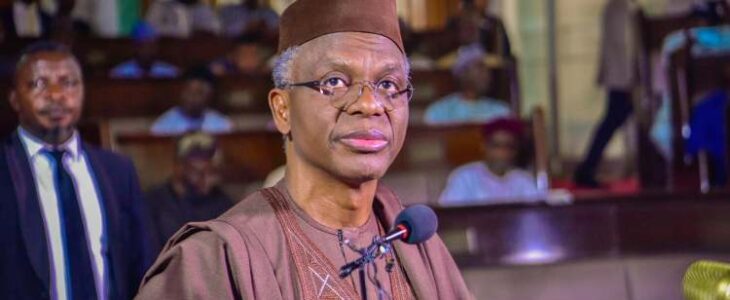
The judge ordered Mr El-Rufai to enter his defence, if he so wishes, in the trial on phone-tapping charges.
The Federal High Court in Abuja has dismissed the no-case submission filed by former Kaduna State Governor Nasir El-Rufai in his trial on charges of unlawful interception of the telephone communications of National Security Adviser (NSA) Nuhu Ribadu.
Judge Joyce Abdulmalik, in a ruling on Monday, held that the State Security Service (SSS) had presented sufficient evidence to require Mr El-Rufai to enter his defence, if he chooses.

The judge consequently ordered the former governor, the sole defendant in the case, to enter a defence.
A defendant who fails to enter a defence risks leaving the judge with no option but to foreclose the defence. In that situation, the judge may determine the defendant’s guilt or innocence solely on the strength of the evidence the prosecution presented.

Mr El-Rufai, through his lawyer, Akinyemi Aremu, had urged the court to hold that the prosecution failed to establish a case against him to require him to enter defence.
However, the SSS lawyer, Oluwole Aladedoye, a Senior Advocate of Nigeria (SAN), opposed the submission.
Mr Aladedoye argued that the defence failed to address Exhibit B, which the prosecution said contained Mr El-Rufai’s alleged admission concerning the interception of Mr Ribadu’s telephone communications.
Mr El-Rufai, who has been in the custody of the Independent Corrupt Practices and other related offences Commission (ICPC) since February, maintained that the prosecution had established a prima facie case against the former governor.
Backstory
The SSS filed the charges against Mr El-Rufai following comments he made during an interview on Arise Television in the aftermath of a failed attempt to arrest him at the Abuja airport upon his return to Nigeria from a foreign trip in February.
PREMIUM TIMES reported that SSS operatives attempted to arrest Mr El-Rufai on 12 February, following his arrival from Cairo, Egypt.
While the arrest was unsuccessful, the security operatives seized the former governor’s passport.
The following day, Mr El-Rufai alleged during a live interview on ‘Prime Time’, an Arise Television programme, that Mr Ribadu was behind the alleged attempt to arrest him at the Nnamdi Azikiwe International Airport, Abuja.
He said he knew Mr Ribadu ordered his arrest from listening to a wire-tapped phone call made by Mr Ribadu instructing security operatives to carry out his arrest.
Charges and trial
Following the interview, the SSS charged him with five counts relating to the alleged unlawful interception of telephone communications and other offences under the Cybercrimes (Prohibition, Prevention, etc.) Amendment Act 2024 and the Nigerian Communications Act 2003.
Mr El-Rufai pleaded not guilty to the charges when he was arraigned in April.
The prosecution called two witnesses before closing its case in June.
The first witness, an SSS operative identified in court by the code name APC, testified about the agency’s monitoring and preservation of the recording of Mr El-Rufai’s television interview.
The prosecution also called lawyer and human rights activist Deji Adeyanju, who testified about the interview.
Mr Adeyanju told the court that he was at the Arise Television studio in Abuja when Mr El-Rufai gave the interview. The court also watched a recording of the programme.
During his testimony, Mr Adeyanju confirmed that the recording reflected what he witnessed during the interview.
Under cross-examination, he told the court that he heard Mr El-Rufai say, “we listened to their calls”.
However, he acknowledged that Mr El-Rufai did not expressly say that he had personally tapped the NSA’s telephone.
After presenting the witnesses and its evidence, the prosecution informed the court that it would not call any further witnesses and closed its case.
El-Rufai’s no-case submission
Following the prosecution’s closure of its case, the defence indicated that it would file a no-case submission, asking the court to dismiss the charges without the need for Mr El-Rufai to enter defence.
A no-case submission asks a court to discharge a defendant on the ground that the prosecution has not presented sufficient evidence to warrant a defence.
The prosecution, however, opposed the application, insisting that its evidence was sufficient to require him to answer the allegations.
‘There’s a case to answer’
In Monday’s ruling, Judge Abdulmalik agreed with the prosecution that Mr El-Rufai has a case to answer.
He rejected the defence’s argument and held that the evidence presented was sufficient to require Mr El-Rufai to enter his defence.
This means the former governor will now have to enter his defence if he chooses to contest the charges.
Mr El-Rufai is facing corruption charges instituted against him by the ICPC before two separate courts in Kaduna over his activities during his eight years as governor. He is also pursuing different human rights enforcement cases which arose from the actions of the ICPC concerning him and his family members since his detention by the commission in February. He recently lost two of the cases.
Credit: Premium Times