
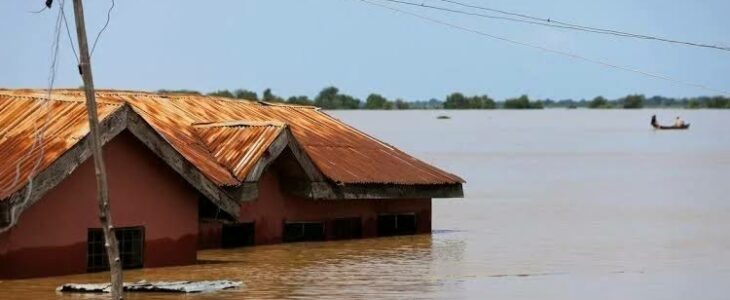
No fewer than 11 communities have been sacked and more than 5,000 people displaced by massive flooding that submerged riverine communities in Doma Local Government Area of Nasarawa State.
LEADERSHIP gathered that the disaster followed torrential rainfall that lasted for three days, with the location of the affected communities downstream of the River Benue worsening the situation.

A resident of one of the affected communities, Emmanuel Ogebe, from Ochekpe, told our correspondent on the telephone that the flood submerged maize, groundnuts, rice and other crops that were due for harvest.
He said the rain began with a drizzle last Tuesday before intensifying the following day, submerging several communities and washing away houses.

According to him, the affected communities remained inaccessible for days after the flood cut off the road linking them to the headquarters of Doma Local Government Area.
They said they had to travel by speedboat along the River Benue from Makurdi, Benue State, to reach the submerged communities.
The NSEMA director-general confirmed that the road linking Doma to the affected communities had been completely ravaged and submerged, making it impassable.
“Because of the condition of the road, the road has been so ravaged by the flood that if we were to go by road, it would have taken close to six or seven hours. It was a lot easier to come through Makurdi and take a flying boat,” he explained.
“As I speak, the motor road linking those areas from Doma is completely impassable. It is through Makurdi, by boat, that people now access their homes.”
Describing the impact of the disaster, the director-general said the flooding had left hundreds of households submerged, destroying homes and livelihoods and creating serious challenges for access to potable water.
“The level of flooding was so massive, so devastating, that it left in its wake very challenging circumstances. Hundreds of households were completely submerged in water, thereby affecting means of livelihood and shelter, and you could see the challenge of potable drinking water,” he said.
“In some of these communities, you have to roll up nearly half of your trousers because the water level is so severe. Cornstalks were wiped out.”
On the number of people affected, the NSEMA chief said a preliminary assessment indicated that between 4,000 and 5,000 people had been affected, while about 11 or 12 communities were impacted.
“Honestly speaking, the affected communities are in the region of 11 or 12. The number of people affected is in the region of 4,000 and above. It shows you that the whole thing is so massive. Some of these people have already been relocated and are taking shelter in neighbouring communities. It’s in the region of 4,000 to 5,000,” he stated.
He attributed the flooding to heavy rainfall and the overflow of the River Benue, adding that the agency had received a flood alert on May 9 indicating that three local government areas—Toto, Nasarawa and Doma—were at risk of flooding this year.
He said the agency had sensitised residents of riverine communities about the risk but warned that the situation could worsen with the impending release of water from a dam in Cameroon.
On relief efforts, Commissioner Baba Shehu said the state government, through his ministry, was working to ensure that affected residents and communities received the necessary assistance.
The NSEMA director-general also confirmed that the Ministry of Humanitarian Affairs and the agency were procuring relief materials for the victims.
He said the ministry would provide food items, while NSEMA would supply non-food items, including mattresses, blankets, mosquito nets, cement and roofing sheets, as many houses had been severely damaged.
“The relief materials we are looking to take to them include food items, which are being handled by the Humanitarian Ministry, while we at NSEMA are handling non-food items such as mattresses, blankets, mosquito nets, cement, roofing sheets and the like. This is because most of the houses are already giving way; they are falling apart,” he said.
The director-general urged residents to comply with building standards and avoid constructing houses on floodplains and waterways.
“People need to be very careful where and how they construct their houses. People build not only along floodplains but without regard for waterways. They don’t create space or channels for water to pass seamlessly. You find people’s dustbins, refuse and all manner of waste along water channels, further aggravating the situation,” he warned.
Credit: Leadership