
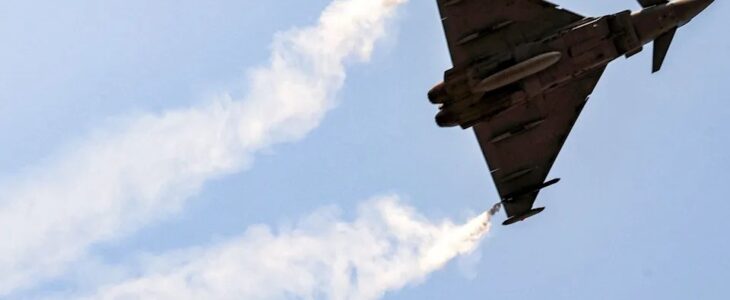
Houthi rebels claim to have shot down one of Saudi Arabia’s Eurofighter Typhoons sold to the kingdom by Britain.
Footage released by Houthi-affiliated media showed a jet bursting into flames after a projectile streaked towards it.

The Typhoon is among the fighters Britain has sold to Saudi Arabia under a long-running arms relationship, including 72 jets through a deal known as Project Salam – “salam” is Arabic for peace – reported at £4.43bn.
London has long called the kingdom an “important strategic ally” in the Middle East, and the downing, if confirmed, would be a rare combat loss of the aircraft to an Iranian-supplied air defence.

Steven Wagner, a senior lecturer in international security at Brunel University of London, said the aircraft did appear to be a Eurofighter Typhoon but questioned whether it had been destroyed.
“I didn’t clock a direct or catastrophic ‘hit’ here, except perhaps at the very beginning, although the explosion toward the beginning looks close,” he told The Telegraph. “The pilot uses good manoeuvres and flares to evade.”

Mr Wagner said the weapon was “likely a standard Iranian mobile system,” and that the key question was “how long that’s been in play, and whether it arrived before or after the blockade”.
Such mobile surface-to-air missile systems, he explained, catch out fourth-generation jets such as the Typhoon through ambush.
“Mobile systems are only activated moments before they are ready to fire, or else their radar’s emissions would attract Saudi radar-seeking missiles,” he said. “They are switched off and repositioned just as quickly.”
Stealthier aircraft such as the F-35 “would be somewhat safer from these systems, but not entirely so”.
The effect, he added, was to push Saudi jets further from their targets, but he cautioned against reading too much into one loss.
“It’s too far to say that the Saudis are incapable of defending themselves,” Mr Wagner said.
“This one pilot certainly appears to have been caught out by these tactics. Such mistakes won’t likely be repeated, and so this particular Houthi tactic will decrease in effect every time it’s used. Both sides will adapt.”
On the ground, fighting has intensified between the Houthis and Saudi-backed forces spearheaded by the Southern Giants Brigades.
In a sharp escalation, the Houthis struck at the seat of Yemen’s internationally recognised government for the first time, firing five missiles at the al-Maashiq presidential palace in the southern port city of Aden.

Two security guards were killed, the government said, but all cabinet members, including the prime minister, were unharmed in what officials called an assassination attempt.
The strike deepened fears among Yemenis of a slide towards an all-out civil war that could draw in powers beyond Saudi Arabia. The kingdom has been lobbying other Muslim nations and Donald Trump to join the fight and casting the Houthis as a threat to global shipping.
Brig Gen Yahya Saree, the Houthi military spokesman, declared most of Saudi airspace and airports “unsafe” on Thursday, except “the holy airspace over Mecca and Madina”.
‘First terrorists with explosive-laden speedboats’
His statement followed a news conference by the Saudi-led coalition, whose spokesman, Maj Gen Turki al-Maliki, said the Houthis had become “the first terrorist group to have ballistic missiles, attack drones and explosive-laden speedboats”, with technology obtained “with the assistance of regional parties”.
He said Houthi attacks on Riyadh’s King Khalid international airport had killed 17 people and wounded 333 between Oct 7 and 11, and that the airport had been hit 20 times since Oct 1.

Saudi-backed forces reported carrying out 1,250 attacks against the Houthis in the past 24 hours under their “Dawn of Yemen” campaign to retake rebel-held territory, using combat aircraft, drones, artillery and rocket launchers.
Pro-government forces said they were repelling a Houthi attack on Dhubab airport on Thursday night.
The Homeland Shield Force said it was securing the airfield, in the coastal city of Dhubab in Taiz governorate, together with the Southern Giants Brigades, as government-allied units pressed toward the Bab al-Mandeb strait and fought the Houthis in parts of Dhubab district.
The fighting is fuelling a public health emergency.
Cholera cases in southern Yemen have tripled in the past three weeks as displaced people crowd into camps with little clean water or sanitation, the aid group Islamic Relief warned.
“Thousands of lives are at risk,” it said, adding that 200,000 people had been pushed into “overcrowded and polluted camps”.
Credit: Yahoo News