
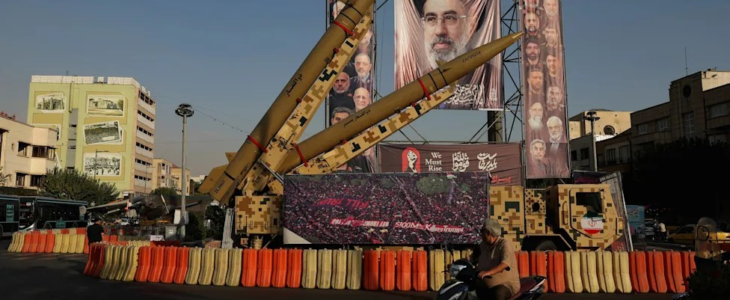
Over the last several weeks, there has been a concerning trend playing out in the Strait of Hormuz… It’s not just the Strait of Hormuz anymore… and these aren’t “little strikes”.
According to the UKMTO, which is the primary open-source tracking database for verified vessel strikes, the past several weeks from October 7th have seen (at minimum) vessels struck off Oman, Saudi Arabia, Qatar, UAE, and Iraq. If you would like a free geography lesson, that is NOT the Strait of Hormuz anymore.

But it’s not just the location of these expanded strikes that is significant, but also the severity of the strikes that is particularly notable. For several months, many people questioned the capabilities of Iran’s military after Operation Epic Fury caused immense damage as a result of thousands of bombing campaigns carried out by the United States. Yes, Iran was striking vessels, but it wasn’t at a notable scale, and the strikes weren’t causing significant damage.
Well, that’s over now. In the month of October, Iran has now struck THIRTY vessels in three and a half weeks, with the UKMTO itself publicly acknowledging that “a majority” of vessel strikes are not being reported to UKMTO. This would mean that at LEAST SIXTY vessels are likely to have been struck by Iran in the last 26 days. With expanded locations… And now these vessels are being sunk outright, lit ablaze, blacked out, or disabled entirely.

That is a VERY different risk now for vessels attempting to transit the Omani Route, defy Iranian demands, and put blind faith in a US Navy that is proving to be woefully incapable of adequately defending these transits. What’s a few million dollars of damage to your vessel from a minor strike when you are making orders of magnitude more from greater prices? But now you need to worry about your vessel being sunk, being destroyed, or your crewmembers being injured or killed. It’s a new ballgame taking place in the Middle East now.
But beyond this, we have also seen unavoidable signs that Iran has a HUGE stockpile of available drones, cruise missiles, and anti-ship ballistic missiles that show that they either have A) a far greater stockpile than we were initially led to believe by CENTCOM, B) a far more robust remaining military-industrial complex that survived Epic Fury, or C) a combination of the two.
In the past three weeks, Iran has been running large-scale tests of its missiles to refine and enhance their capabilities. It can be conservatively estimated that Iran has fired at LEAST 100 missiles in testing over the last three weeks… that’s not something you would do if you were “just about to run out of munitions”. This is an obvious conclusion to draw. Iran has significant remaining stockpiles, and/or a very robust remaining military-industrial complex to continue waging this war against the United States almost perpetually.
What has also become increasingly clear is that Iran simply was not TRYING to strike as many vessels as possible, in the most severe ways possible, particularly from July, when the MOU collapsed, to September. Then, as the Israelis came closer to their elections and the US came closer to the midterms, Iran SIGNIFICANTLY ramped up the scale of their attacks on vessels in the region.
What we are seeing play out in the month of October is a clear display from Iran of what most SERIOUS analysts had forecasted: They haven’t seriously been trying as hard as possible to shut down Hormuz, they retain enormous capabilities and stockpiles of munitions, and they can and WILL escalate aggressively in any return to all-out war between Iran, the United States, and Israel.
The past several weeks have made it abundantly clear through missile tests, vessel strikes, and target location expansion that Iran retains a far more robust ability to impose severe costs on the global economy if President Trump and the Israelis make the reckless and delusional decision to return to all-out war against Iran.
There is no pathway to victory for the United States in the Iran War. There is only guaranteed destruction of Gulf infrastructure and the global economy.
This will end as everyone expects. Catastrophically.
Credit: Yahoo News