
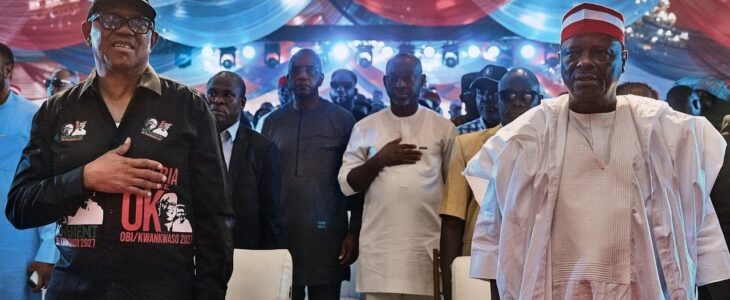
Obi promises to rescue Nigeria, provide intelligence-driven security
The Nigeria Democratic Congress (NDC) has affirmed Mr Peter Obi as its presidential candidate for the 2027 general elections, with Rabiu Kwankwaso named as his running mate.
This was announced at a Special Convention in Abuja on Thursday, witnessed by officials of the Independent National Electoral Commission (INEC).
Obi, in his acceptance speech delivered before party leaders led by National Chairman Seriake Dickson, National Working Committee members and delegates drawn from across the country, declared that Nigeria was standing at a dangerous crossroads marked by uncertainty, fear and declining public confidence in governance.

He said the country was “enveloped in uncertainty”, warning that “families are anxious about their safety; parents are concerned for their children’s futures; and talented youth increasingly question their prospects in their homeland”, while also lamenting that “businesses are struggling, communities are suffering, and an alarming number of citizens have lost faith in the very concept of governance.”
Despite the grim assessment, he insisted that national despair was not inevitable, stressing that “a New Nigeria is Possible”, a phrase he repeatedly anchored as both a conviction and a political mission.
He described his candidacy as going beyond personal ambition, saying it concerned “the essence of our nation and the future of our children”, and urged Nigerians to see the moment as one that demands urgent rebuilding of trust, institutions and national unity.
On the state of the country, Obi warned that Nigeria’s divisions along ethnic, religious, regional and political lines were weakening its foundation, arguing that “Nigeria cannot advance while fragmented” and calling for a shift from mistrust to cooperation.
He urged citizens to “build bridges where others erect barriers”, adding that the country must not allow internal fractures to destroy its future, warning, in reference to Will Durant, that “a great civilisation is not conquered from without until it has destroyed itself from within”.
Security featured prominently in his address as he highlighted worsening global terrorism impact rankings, noting Nigeria’s rise from eighth in 2022 to sixth in 2024 and fourth in 2026 among the nations most affected by terrorism.
He contrasted this with Nigeria’s earlier reputation as a global peacekeeping leader, referencing the country’s role in missions across Rwanda, Liberia, Sierra Leone, Sudan, Mali, Lebanon and Haiti, among others, as well as the leadership of Nigerian officers such as Lt Gen Isaac Obiakor (retd).
The former Anambra State governor said the present situation, where “citizens live in trepidation”, demanded urgent action, stressing that “the primary responsibility of government is to ensure the safeguarding of lives and property”, while pledging an intelligence-driven, technology-enhanced and community-focused security strategy that would also address poverty, unemployment and marginalisation.
On healthcare, Obi described Nigeria’s system as deeply broken, noting its global ranking of 157th and stating that only “10% to 20% of approximately 30,000 primary healthcare centres” are operational, a situation he linked to high infant mortality and low insurance coverage of about 10 per cent.
- Home
- National
- Columns
- Business
- China News
- Politics & Power
- Opinion
- Entertainment
- The Sun TV
- Sporting Sun
- The Sun Foundation
NDC affirms Obi-Kwankwaso presidential ticket
30 May 2026 9:00 pm WATBy Tokunbo2
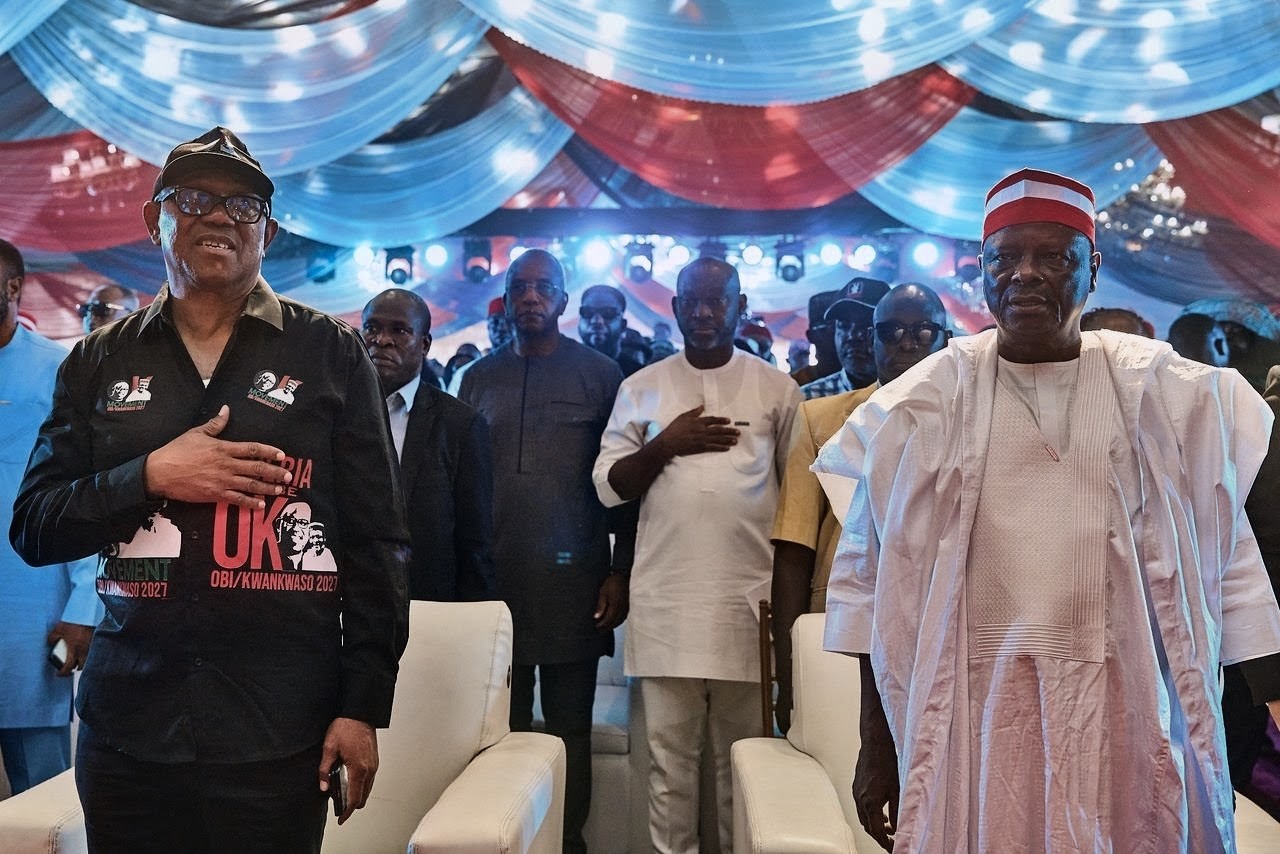

Obi promises to rescue Nigeria, provide intelligence-driven security
________________________________________________________________________
From Adesuwa Tsan, Abuja
The Nigeria Democratic Congress (NDC) has affirmed Mr Peter Obi as its presidential candidate for the 2027 general elections, with Rabiu Kwankwaso named as his running mate.CardiotonIf Your Blood Pressure Is Over 145/80, This Might Be WhyLearn more
This was announced at a Special Convention in Abuja on Thursday, witnessed by officials of the Independent National Electoral Commission (INEC).
Obi, in his acceptance speech delivered before party leaders led by National Chairman Seriake Dickson, National Working Committee members and delegates drawn from across the country, declared that Nigeria was standing at a dangerous crossroads marked by uncertainty, fear and declining public confidence in governance.
He said the country was “enveloped in uncertainty”, warning that “families are anxious about their safety; parents are concerned for their children’s futures; and talented youth increasingly question their prospects in their homeland”, while also lamenting that “businesses are struggling, communities are suffering, and an alarming number of citizens have lost faith in the very concept of governance.”
Despite the grim assessment, he insisted that national despair was not inevitable, stressing that “a New Nigeria is Possible”, a phrase he repeatedly anchored as both a conviction and a political mission.
He described his candidacy as going beyond personal ambition, saying it concerned “the essence of our nation and the future of our children”, and urged Nigerians to see the moment as one that demands urgent rebuilding of trust, institutions and national unity.
On the state of the country, Obi warned that Nigeria’s divisions along ethnic, religious, regional and political lines were weakening its foundation, arguing that “Nigeria cannot advance while fragmented” and calling for a shift from mistrust to cooperation.
He urged citizens to “build bridges where others erect barriers”, adding that the country must not allow internal fractures to destroy its future, warning, in reference to Will Durant, that “a great civilisation is not conquered from without until it has destroyed itself from within”.
Security featured prominently in his address as he highlighted worsening global terrorism impact rankings, noting Nigeria’s rise from eighth in 2022 to sixth in 2024 and fourth in 2026 among the nations most affected by terrorism.
He contrasted this with Nigeria’s earlier reputation as a global peacekeeping leader, referencing the country’s role in missions across Rwanda, Liberia, Sierra Leone, Sudan, Mali, Lebanon and Haiti, among others, as well as the leadership of Nigerian officers such as Lt Gen Isaac Obiakor (retd).
The former Anambra State governor said the present situation, where “citizens live in trepidation”, demanded urgent action, stressing that “the primary responsibility of government is to ensure the safeguarding of lives and property”, while pledging an intelligence-driven, technology-enhanced and community-focused security strategy that would also address poverty, unemployment and marginalisation.
On healthcare, Obi described Nigeria’s system as deeply broken, noting its global ranking of 157th and stating that only “10% to 20% of approximately 30,000 primary healthcare centres” are operational, a situation he linked to high infant mortality and low insurance coverage of about 10 per cent.
He pledged that, within four years, his administration would raise health insurance coverage above 20 per cent, increase healthcare spending to at least 10 per cent of GDP from below 5 per cent, ensure fully functional primary healthcare centres in all 8,809 wards, and restore at least half of the nation’s 30,000 primary healthcare facilities to full operation.
Obi, who was the Labour Party presidential candidate in the last election, also placed education at the centre of his vision, describing it as the foundation of national revival and insisting that investment in schools, teachers and vocational training would transform Nigeria from a “cycle of shared poverty to one of collective prosperity”.
On hunger, he cited Nigeria’s worsening position on the Global Hunger Index, noting its fall from 109th in 2023 to 115th in 2025, while warning that more than 35 million Nigerians face acute food insecurity.
On the economy and infrastructure, Obi said Nigeria’s electricity deficit remained a major constraint, noting that the country generates only about 4,000 megawatts for more than 200 million people, and promised to increase power generation and distribution by at least 10,000 megawatts within four years.
He also challenged official unemployment figures, arguing that real underemployment and youth unemployment exceed 30 per cent and 40 per cent, respectively, pledging targeted support for micro, small and medium-sized enterprises through tax incentives and sectoral investment.
On governance, Obi promised a measurable reduction in corruption and public-sector waste, insisting that government resources would be managed with “absolute transparency, prudence, and accountability”, while pledging that “the rule of law will be fiercely upheld.”
The convention formally ratified the Obi/Kwankwaso ticket after Victor Umeh moved the motion for affirmation, declaring that the party was united “in accordance with the provisions of our party’s constitution”, while Omo-Agege seconded the motion, expressing “hope, excitement, and great expectation.”
In his remarks, NDC National Chairman Moses Cleopas described Obi’s candidacy as the nation’s central hope.
“It is like a dream to many of us who are students of the political school led by the leader and founder of this party,” he said, noting that the party had grown from registration barely three months ago into a nationwide movement.
“Here we are today, conducting party primaries across the length and breadth of the country… the remaining hope for this country is Mr Peter Gregory Obi,” he added, describing the party as “the party of hope” and calling its mission “a sacred duty”.
On his part, the national leader of the party, Seriake Dickson, reinforced the party’s message of renewal, noting that Nigerians had continued to show resilience despite hardship. “Despite the challenges facing our nation, particularly insecurity and economic hardship, Nigerians continue to demonstrate resilience and hope for a better future,” he said.
He then formally presented the party symbol to Obi, declaring, “On behalf of the National Chairman, I have the honour of presenting this symbol of victory, this symbol of salvation, this symbol of rescue—the NDC flag,” describing it as “the flag of a party that has become the hope of millions of Nigerians.”
The event sealed the NDC’s entry into the 2027 race with what party leaders described as a mission to rebuild a fractured nation.
Credit: The Sun