
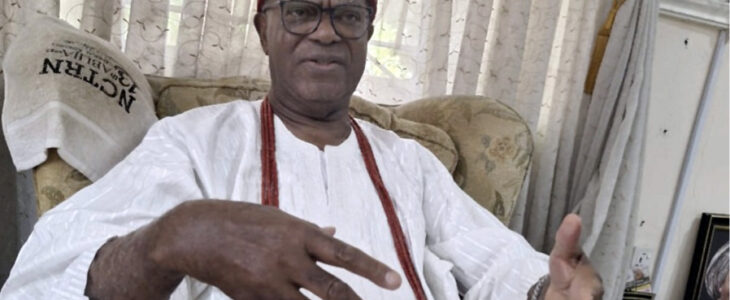
On Thursday, His Royal Majesty, Igwe Alfred Nnaemeka Achebe (Agbogidi), turned 85 years. Same day, the revered monarch clocked 24 years on the ancient throne of Onitsha, Anambra State.
In this concluding part of the special interview published in Daily Sun of Friday, Igwe Achebe spoke on Ohanaeze Ndigbo’s ban of Eze Ndigbo title in the Diaspora, the state of the economy, his joy and regrets, among others.

But what is your own personal view about the continued incarceration of Nnamdi Kalu? The other day, we saw one of you, Igwe Lawrence Agubuzu, telling President Bola Tinubu to release Nnamdi Kanu?
Igwe Agubuzu belongs to this group, the Joint Body of the traditional rulers, religious leaders and the civic leaders. So, he was speaking, both for the traditional council and for the doint body. We’ve worked very hard on the release of Nnamdi Kanu. We actually offered to take him; that he should be handed over to us. A lot of discussions have to go on, including Nnamdi Kanu himself accepting to blend back into society and play a different role. You can still play a leadership role, but in a positive sense. But calling for Biafra that doesn’t have a map and establishing a government that has no mandate; you are looking for freedom and yet your process does not reflect freedom of expression and freedom of choice and all of that. So, all that has to go and his incarceration, I believe have brought about a change in his personality. Mandela went through a process of change; Obasanjo went through a process of change. So, we’ve worked hard to release him. We’ve written letters to the President. Our members are allowed to visit him and they’ve visited him and had conversation with him.

Is it in Abuja or Sokoto?
No, in Abuja. Our members have not gone to Sokoto to see him. Archbishop Chibuzo Opoko, the Methodist Archbishop of Umuahia, is a member of our group. Of course, being from Umuahia with Nnamdi Kanu, he also plays a particularly strong role. Mistakes have been made. The young ones have been misguided, but an initiative, however, utopian it was, Ndigbo should be free. The young ones are asking we the older ones, ‘what are you doing about the marginalisation of Ndigbo?’ And if you don’t explain it to them, they would want to do it by themselves because the future belongs to them. But then you create an utopia and people join and at the end of the day, it’s like a balloon; it will burst. Lives have been lost, but if you don’t apologise and forgive ourselves, we cannot go forward.
My joint body is looking more about how to repair the damage that has been done and how to move ahead as a people. We all as Ndigbo have to work together about it. That’s all I can say about it.
What has been the relationship between the traditional authority and your state government since you became Obi?
Generally positive, generally constructive. I started off with Chinwoke Mbadinuju as the governor, who was in the second half of his tenure and you know, the Obi of Onitsha doesn’t get the Staff of Office or Certificate of Recognition because of our antiquity, but the government will write a letter to acknowledge that Onitsha, we have made our king following our own customs, tradition and due process. And the local government chairman who is on ground has to assure the government that the process has gone on, and then the government will now issue a letter to congratulate you. Mbadinuju did that and the letter was signed by the Deputy Governor who had the responsibility for traditional matters. We went on very well. His time wasn’t too long, but he came to my first Ofala. I ascended the throne on the 14th of May, on my birthday and Ofala was October, so Mbadinuju said in five months we had transformed Onitsha; because there was so much joy, happiness everywhere. Then, Chris Ngige became governor. Chris I knew before I became Obi of Onitsha because my family and his mother’s family had good relationship. They are from Nnobi. So, I knew him through the Okafor family of Nnobi. And we got along very well. When he was kidnapped we all played a role; very strong role. At some point, we had a misunderstanding; bound to happen. But we made up again.
Then came Peter Obi. Peter Obi appointed me as Chairman of the Traditional Rulers’ Council, Anambra State. Again, we worked very well. Peter Obi’s approach was just get on with it. Anything you need, you let me know and I will make provision for that. He didn’t dabble into the details of how we run the traditional council. And we did very well. We had our annual seminar and we published the first volume under Peter Obi; had the presentations at the seminar. Then came Willie Obiano and again we worked very well. Willie was a cabinet chief in Aguleri so he was a bit more hands-on because he understood a bit more than Peter Obi. I was still the chairman. I wanted to step down after Peter, but Willie said no, please continue. And I continued. And at the end of eight years of Willie, I wanted to step down again, he said I should wait until his successor came in and I could discuss with him. Then came Soludo. Soludo has a different idea, which actually I share because the council was about 60 something people. And we have 181 communities. So, if you figure that maybe 20 or 30 communities were in transition of getting a new traditional ruler, we still have about 150 traditional rulers of which only about 70 belonged to the council. The other ones were not in the council. Some of them are professors, medical doctors, barristers and all of that who can be useful to the process of our discussion. So how do you roll over, create a stay in office, you have been in the council for three years or five years and you can retire, somebody else will come in and all of that.
These were in my mind. And it was in Soludo’s mind also, including the chairmanship. I had tried twice to step down; eight years, 16 years. So, the amended law came up with the term of office for the chairman, but then, all the traditional rulers in Anambra State became members of the council which is positive. And that’s what we have today. So, there is no problem.
So it was not as if the two of you quarrelled or had a misunderstanding?
No, the impression of quarrel was misplaced. The Commissioner for Local Government and Chieftaincy Affairs was the target of my observations. When you write a memo and backdate it as if it had effect and the memo was not done in consultation, and when you called me and told me that you were under pressure to issue a press statement; and at the time you were calling me that statement was already out, two days before and you are saying that you are under pressure to issue the statement that you had already issued, is that not a misrepresentation? And when you suspend a traditional ruler by publishing it on social media without the traditional ruler getting to know for the first time that he was under suspension, is that the way to run things? And literally, over 60 per cent of the council members are old enough to be his father. And he has a basic Bachelor’s degree.
Two members of the traditional council have the Nigerian National Order of Merit at the time we are talking about; Chukwuemeka Ike who is late now and Laz Ekwueme who is still alive are there. We have professionals, Deputy-Vice Chancellors, etc. So, why should a young man of limited knowledge in life be playing around with traditional rulers because he’s sitting in government? That was my anger and I wrote about it. And the government immediately called the meeting of all the traditional rulers and we agreed to resolve all the issues. I spoke with the traditional rulers and said I had discussed with the governor and that the suspension on Igwe Neni will be lifted. Igwe Abacha will also be restored. And that’s it.
So what can we say is the current relationship between the governor and the Onitsha Traditional Institution as we speak?
He has done me a great favour because finally, by amending the law the tenure of the chairman of the council, I think it is now four years. I had been there for 20 years. So, I had to step down. What I had been looking for since Peter Obi’s time, since Willie Obiano’s time is happening now by the law. So, I am happy to step down. I have more time for some other things. I am doing a lot of writing. I am hoping that I will leave three volumes for Onitsha people. It’s my legacy and to get Onitsha people going forward on Onitsha traditional jurisprudence. All the cases that I have adjudicated upon; all have implication for our culture. There won’t be problem again going forward because there are references there. Then, on the governance and then on the transformation journey.
I have done two books already which are in public domain. So, I have more time to do these things rather than going to Awka every day; you know, you are invited and all that. Then, of course, representing the state at various meetings of traditional rulers’ council. The new chairman does that. That’s it. The South East body of the traditional rulers have designated me as the leader in the same manner as the Sultan in the North and Ooni of Ife in the South-West. But we still have a chairman of the South East Council of Traditional Rulers that rotates every two years. The current chairman is the chairman of Imo State, Eze Emmanuel Okeke.
So, are you expecting the governor to attend the 24th anniversary that is coming up next week? We can’t remember seeing him in any of your Ofala?
He was in Ofala two years ago. Last year he didn’t come. He came two years ago with his wife and daughter who at that point, the process of marrying her was ongoing. We married her since then. So, he is our in-law. We will extend the invitation to him. If he comes, we will receive him and receive him properly. If he doesn’t come, Ofala goes on.
The Ofala festival is a centrepiece of Onitsha culture. How have you preserved and repositioned it for younger generations in the digital age?
Ofala is a very traditional festival. It’s once a year that the Obi of Onitsha comes out to his people after a period of seclusion. That period of seclusion is like a retreat. It’s a retreat actually. The churches go on retreat and all that. So, he goes on a retreat and he is completely on his own for one native week. He sits on the floor, doesn’t take a bath; doesn’t shave, eats once a day for health reasons. During that period, you are on your own. You take your mind to different level. What has happened in the community in the last one year, good and bad; let God forgive us for our transgressions. You pray for the future; let there be a better future, enough harvest for people to eat; no crimes and all of that. Whilst you are there, traditionally in the olden days, when we fought border wars for land with our neighbours, where the Obi is, is a secret. And so our borders are being watched to make sure our enemy communities don’t come and hijack the Obi because the Obi symbolises the community. He’s like the queen bee. If the queen bee dies, that colony is dead. If the Obi of Onitsha is kidnapped or murdered by the enemy, Onitsha is decapitated. So part of that ceremony is that before Obi emerges, the chiefs will have their own ceremony where they’ll report that all the borders are safe. Then on the Ofala day is the triumphant emergence. People, even the average Onitsha people, don’t know all of these things that go behind the ceremony; the sacrifices, the prayers and offerings and all of that. So, that was how it was before.
Since I came on to the throne, we are in the age of transformation and modernisation. You decided consciously to make Ofala bigger. So, there is an economic aspect to Ofala. Our people are making dresses, foods and others. It’s all money making. And our native restaurants are busy because visitors will come and eat. That is the creative aspect. We have an art exhibition that goes on and there’s an aspect of projecting Onitsha to the world and bringing people to come in; tourism, which has been restricted by the quality of hotels we have in Onitsha, but that has changed because one or two top class hotels have come on. So, it’s getting bigger, and bigger every year. And we are getting sponsorships. Globacom has been with us for about 12 years now, International Breweries has been with us; Diamond Bank was with us until they merged with Access Bank. Access hasn’t picked it up, but Zenith has come on board. Other companies are coming to support us. Our people, we also raise money ourselves. So, it’s getting bigger and bigger. In fact, at the end of each Ofala, we have a surplus which we now apply to our development programme. The palace has been modernised, expanded and all of that. So, that is what Ofala has transformed to be.
Last year, Arise TV came to Onitsha and covered the two days, beaming it live. After that they connected me with Rufai Oseni and his colleagues and they had a live interview and so on. We are going to keep pushing it because that is the future. It is lifestyle. It is entertainment. It is culture. Argungu Fishing Festival is doing that; Ojudu Oba at Ijebu Ode. Abeokuta has the Ake Festival. Benin has a festival. So, we are part and parcel of it. At the end of the day, it’s all contributory to the Nigerian push for tourism, for lifestyle and all of that; and that’s what we are doing. We have a second programme which holds in December which we call Golibe Festival. Golibe is conceived by our youths and run by our youths. We give them support. And we believe that in the long run Golibe is going to be bigger than Ofala because Ofala is restricted by tradition. Golibe is not restricted. It is a street carnival. It’s talent development. Talent hunting both literally and musical talent, art creative talent and all of that; all designed to get the youths going. It’s their own programme; we the adults support them. They have corporate sponsors also. That’s where we are heading to.
We have applied and we are working with the Federal Ministry of Culture and Tourism for recognition by UNESCO as a global asset which will be a big endorsement for us. The International Association for Tourism has recognised us; and the Nigerian Tourism Corporation also gave us recognition. So, we are going from strength to strength. We are already deeply involved in planning the Ofala in October. That’s how we are going about it.
So, this aspect of the Ofala, the sacrifices and the rituals, you mentioned, is it that they have been abolished totally, because I know that some people believe that the Obi of Onitsha is invincible; that his enemies can never get at him? Have you raised an army to protect yourself?
The biggest army is God. If you keep your hands clean, by luck you’ll survive. But as part of my enthronement as Obi of Onitsha, you have to swear to protect all the Onitsha deities and shrines. And I have had the occasion of emphasising that no single Onitsha deity or shrine is malevolent. They are all benevolent. People will go to our shrines like Ojeedi. Ojeedi is a woman. So, when women are seeking children and they’re not coming, they go and make sacrifices to Ojeedi. Ojeedi can pray to God. Our shrines and deities are intermediaries to God. They don’t have the power of God. They are intermediaries. Otumoye is a man and his family; and he is a shrine for justice. So, if you feel that you have been unfairly treated by your community, by your family or anybody and you have made every effort to get justice, you go to Otumoye and make sacrifices. Otumoye should help you to pray to God that what belongs to you should be yours and all of that. So, that’s the way. Ite Ofe is on the river bank. Ite Ofe, if you go there, there is lot of fish. So, people go there to make sacrifice for bounty; the food to eat and all of that. That’s what it is all about. Like I said, they are not malevolent. Whether it works or not is not what is important. We do it to remember how our ancestors lived when there was no medical science. Then when a child suddenly dies, they say it is Ogbanje. Dibia (native doctor) will come and take money from you. Now we know that Ogbanje is sickle cell anaemia. How do you stop it? It’s by selection. Somebody whose genotype is AS should not marry another who is also AS. In the past, twin gets thrown away. Thank God that Okosi 1 had a set of twins. So Okosi II is a twin. Okosi 1 had his background in the Catholic Mission. People are now proud to have twins. My wife comes from a family of twins. So, if you are well grounded in the principles of the church, you don’t have to be a pastor. And some pastors are not grounded because they don’t have the depth of articulation. And you also know that Onitsha tradition or you can say Igbo tradition, but Onitsha tradition, because in Igboland our traditions vary also.
I will talk about Onitsha. I have made statements in the churches that in Onitsha tradition and Christianity, that there is no irreconcilable difference between the two. But the people who cause trouble are the extreme ones, both on the church side and on the traditional side. Some people go to church for one reason or the other. Some go there to give themselves stature. I went to church once and I sat, I think, in the second row somebody came and whispered to me that this is reserved for the Knights of the church. So, if I am not a knight I cannot sit down in the church. In the eyes of God, does God reserve any place for knights? It is your goodness as a person. I once tied wrapper as a younger man to church. My children said ‘ah! I hope the priest will not ask you to get out.’ I said if the priest asks me to get out, I get out. Today, even the church is trying to absorb tradition. Sometimes they overdo it.
This week or last week, there is a Catholic church at Awada, they call it Ibaa Pope, the Igwe of Ibaa Pope dressed completely as a traditional ruler. That is rubbish. I have been to the seminary at Okpuno. On a Pentecostal Sunday, I went to worship there with my people. We had a bus load. It was a beautiful service. When we wanted to go they said no that they had a reception for us. We said okay. They started beating their native drums and all of a sudden a masquerade appeared. And I cannot see a masquerade. A masquerade cannot pass in front of Ime Obi.
So, what did you do?
I quickly covered my face. My people screamed no, no, no. Igwe doesn’t see masquerades. And the masquerade ran back again. So, tradition is the way of life of the people. And is actually the foundation for Christianity because Christianity started off in the Middle East – Bethlehem, Jerusalem and all of those places. And the early Christianity was much more of the cultural practices of those people, but based on the principles of truth, honesty, and belief in the supreme God; the veneration of God; which is what we do. Every Onitsha person is a Christian, but we also hold our tradition very strongly.
Recently, Ohanaeze Ndigbo abolished the use of Ezeigbo title in the Diaspora. How do you look at this? And what do you think is the greatest misconception people outside Igboland have about traditional leadership?
I think that the whole idea of Eze Ndigbo is very unfortunate; and it puts Nidgbo in a very bad light, generally as a people. One, you cannot go to somebody’s homeland and create your own domain in somebody’s homeland; on a piece of land that you bought from them or you’re renting from them. And you install yourself as a king. It is the people that install their king and not by somebody else. So, we had somebody in Akure who said he is Eze Ndigbo in Akure. The Deji of Akure sent a message that he should come and see him. He said that he wouldn’t go, that he is in the same class as the Deji of Akure. Of course, they took care of him. And before you could say Jack Robinson, Ondo State government passed a law; Oyo State followed, Lagos followed. They are still going around doing it. They went to Ghana and caused problem for Igbo people there. One person said that he is the king of the Igbo in Ghana. The Ghanaians now reacted. And that’s what is happening in South Africa. It is the guy who called himself Eze Ndigbo that caused this current wave of xenophobia. It is because of that. You don’t only come to make money in our country; many of you are illegal residents; you also call yourself king. And South Africans take their kingship very seriously. And then you look at Igboland; up till the local government review that was led by the then Etsu Nupe who was the top administrator of the Federal Government under the military regime, most of our communities in Ana-Igbo (Igbo land) were self-governing without a traditional ruler. So, we were in the old system of republicanism where the elders of the community and the wise men get together and make collective decisions. So, following that, they said that Ndigbo would start crowning traditional rulers. So, Abia State had Arochukwu as the only established monarch in Abia State from historical times. Abia State today has over 1,000 traditional rulers and they are still growing because once you carve out an autonomous community, they want a traditional ruler and all that.
In Anambra State, we went from whatever the number was to 181 and Chris Ngige said no more. Peter Obi disagreed with Ngige in politics, but he agreed with him on that one. And the successors have agreed on that. If he didn’t stop it, Anambra would have gone on and on. Imo State has about 800. How can you manage those effectively? And most of them can’t even sustain themselves. How can Abia State Government sustain 1,000 traditional rulers when other states are converging? Ijebu Nation under the Awujale of Ijebu has about eight or 10 Local Government Areas under it. So, these are the challenges that we have. Now, that Ndigbo need leadership wherever they are, that is fine. Onitsha has Onitsha Improvement Union in every major city and that is the rallying point. So, why can’t you have Okija Improvement Union, Awka Improvement Union? Why must that be Eze Ndigbo? It’s not even Eze Ndi Awka, but Eze Ndigbo whether you agree or you don’t agree. So, anyhow you look at it, it is wrong and there is no basis for it except personal promotion. It puts Ndigbo in a very bad light.
Freedom of expression and all that is okay; but why do you use freedom of expression to denigrate your own community? You see this red hat, no Onitsha indigene will wear a red hat in Onitsha or outside Onitsha if it’s not Obi of Onitsha or a chief in the cabinet. It is not enforced. It is by your own acceptance that you are an Onitsha indigene. And you do it naturally. No Onitsha indigene will wear a red cap anywhere because it is not his portion. When the thenOba of Benin passed away, I was in Shell then. My immediate subordinate is a Benin man, he came into the office in the morning, his hair shaved. I said what’s happening; he said the lion is in the forest. Then, the expression manager had his hair also shaved. It is natural that when you hear that Oba has gone, every Benin man wherever you are in this world will shave your hair as a mark of respect. And these are the kind of qualities we have to project in Igboland.
Our values have gone upside down. In Onitsha, we have a value reorientation project which is having a hard time because people are used to the old ways of doing things; excessive consumption at ceremonies, looking for money at all costs; not bringing up the children properly and all of that. So, we should focus more as Ndigbo to restoring our core values, honest hard work, honesty, love for one another and sense of community; the community is bigger than I. These are the kind of things we have to project and inculcate amongst our people and not Eze Ndigbo XYZ.
In an era where many youths question tradition, what message do you have for the next generation of the Igbo?
First of all, why do they question tradition? It is because tradition has gone haywire. People have turned our tradition upside down. What is tradition? Tradition is a way of life of the people. Culture is a way that people identify themselves. And the Americans have their culture. The Chinese have their culture. British people have their culture. Even the British and the Scottish, some of their culture are similar to that of Igbo people. You saw the pictures when the queen was buried and all the ceremonies that took place; even inside the cathedral and all of that. At the point where she was no more the queen, she was now Elizabeth because she was in transition. That is what is called Omenana (tradition). But if culture is misrepresented to the young people, they react negatively to it. Culture is the type of food we eat. So, if you put together our way of life – the food we eat, the way we dress, the way we bring up our children, the way we make decisions, the way we bury our dead, the way we marry and all of that, that is it. You cannot marry an Onitsha girl without coming to Onitsha to perform the traditional ceremony, whether you met her in China or two of you are living in China. The families must present them in a ceremony because it is family to family. These are the elements of culture.
There are more, but when the kids are presented with a wrong picture, then they say what’s there for me. The other side of the challenge is social media and communication. CNN is not just a news organisation. It’s an acculturating agency. It makes people think more American. Nigerians at certain class watch Donald Trump and what’s happening in the Middle East than they watch Tinubu and what’s happening in Nigeria. Al Jazera has come up; a bit like CNN, but underneath, they are there to project the Middle East mentality, culture and all of that. Then, of course, the main social media are distracting our children. If you go to Enu Onitsha now, you will see young girls and boys wearing blue jeans. And yet, tying a wrapper is more comfortable and cheaper. And then they wear the blue jeans and the ones that are torn which cost more than the ones that are not torn. That is where our values reorientation comes in. Nke anyi bu nke anyi (our own is our own). We have young men and women who create our own local fashions. Indians have done that. They wear their traditional dress anywhere they go. In America, on Thanksgiving Day, every American must eat turkey because that’s how they started. Thanksgiving is how early Americans, when they arrived, the pilgrims and all that, there was no other thing to eat, they just found turkeys to eat; to remind themselves where they have come from, how far they have come. In America, if you’ve just suddenly switched on the radio and it’s playing the American national anthem, every American there will just stand up for it. We have to acculturate our people. We have to keep doing it because that is what makes us what we are. Ndigbo have their own culture; that is why we are Igbo. The Yoruba have their own culture. We shouldn’t abandon our own, copy another person’s own and hope to survive.
Your Majesty, this Onitsha culture that a man must come to Onitsha to perform the traditional marriage rites, what will happen in times of emergencies like we had during the COVID and when we had serious insecurity in the South East?
COVID brought its own protocols. For example, during COVID some people passed away. We just put them in the ground. At the end of the COVID, we now announced their passing and then did the burial ceremonies. Assuming two kids met themselves in China and decided to get married, and there is COVID, they will get married. At the end of COVID then the ceremonies will be performed. Traditionally, it is deemed that their marriage started on the day of the ceremony.
Looking back at 85 years, what has been your greatest joy, challenge and regrets?
I was born on the 14th of May. My letter of admission to secondary school with full scholarship was received on the 14th of May. My letter of admission to Stanford University with full scholarship was received on the 14th of May. And I mounted the throne of Onitsha on the 14th of May. God had a hand in it. In a sense there is a convergence of key aspects of my life on the 14th of May; and these are the things that I didn’t plan. For instance, I could have also left it on the 14th of May to get married. But no; these things just happened by the actions of other people. So, I consider myself lucky in that sense. And it gives me joy that that convergence took place. There are other things that give me joy. My marriage, my children, my career and others, but 14th of May is very special. And on that day I don’t celebrate. I go to 6 o’clock mass with my bigger family – my cousins and brothers and all that. We come back here and we have breakfast and they go. And I sit here just reflecting on my fortune and thanking God that I am what I am today, which is more than the average person will get. It is a solemn day for me and it’s my big joy in life.
Challenges? In life one gets into challenges. I told you about my time in Columbia University. It was tough. And the war was going on at home. Those at home were dodging bombs. But occasionally they share a sense of humour. When they drink a little palm wine they joke about themselves. I was visiting. I visited twice from America. And I was with a group; professionals, just joking. One of them said ‘ah! Look at this one, when the bomb alarm went off everybody was going to hide either in the bush or somewhere and he was going to the toilet.’ Which apparently was true that some people forget their system and all that. But being outside Nigeria, every single story you hear about the war is magnified 10 times. Oh Onitsha has been attacked and I am in my room trying to study. I can’t read anymore. I’d start crying all night.
The next day ‘oh Onitsha was not attacked.’ What I will point out particularly and by the grace of God I pulled through was my health. I have had two near death incidences. One was pulmonary embolism where my lungs were completely blocked. My heart was not getting oxygen anymore. I was supposed to travel on a Saturday to Britain. I changed my programme to travel on Friday because my last meeting was on a Thursday. And I said why am I wasting Friday; go to Britain. That was what saved my life. And I landed at Heathrow and collapsed. That was in 2013. It was a week after Willie Obiano was elected. I was rushed to the hospital. I was in coma for several days. When I woke up, my wife and children were there smiling. I said what’s going on. I had to go through the whole process. My blood was completely recomposed over a long period of months and all that. That was second lease of life from that time. Then, five years ago I woke up in the morning and couldn’t urinate. My prostrate had swollen. And they called a urologist. Even to put a catheter was a big challenge. It was huge. That was during the COVID; 2021 COVID was still on; which I went to America.
So, how did you manage to go out during COVID?
It was 2021 and COVID protocol had been lifted, but Britain still had their own still because on your arrival in Britain, you are quarantined for eight weeks. So, I went out at the end of May until August, but still they are still doing telemedicine. And even though I was classified as an emergency case, there was queue in the hospital. So, I decided to come back to Nigeria, but I called America; my friend is a physician. He said come over and we will sort it out. So, I came back, got an American visa and went to America and got it done. So, those were the challenges; but again, we thank God for the outcomes. For the regrets, I don’t have regrets. My cousin I have great respect for, is my mentor, and he’s a serious businessman. He has done well. I think I learned from him. He always said in life you win some and lose some. And you just keep moving. So, regret is looking at the back and belabouring the past; if I did this, that wouldn’t have happened. It’s gone, it’s gone. Move on. So, I have occasions that if I had to do it again I wouldn’t do it the same way. But why bother, because it’s not going to come again. Just move on. What is ahead is better. That’s my philosophy.
What will the Onitsha people remember of your 24-year reign as Obi and what is your vision for the commercial city and the traditional institution in Nigeria in the next 10 years?
I think that question should go to Onitsha people. You are asking me to score myself. It is difficult, but I can tell you at least what we’ve tried to do. My first objective was to build peace in Onitsha. If there is no peace, there is no development. And there is so much internal squabbles; fighting for land, fighting for headship of family and all of that. So, we went into that and resolved it, starting from my own kindred. Even those people who said that I should come and be Obi of Onitsha had two factions. I cannot be solving problems for other different groups and villages without resolving my own first. So, we did that. We have done well on that, I think. I have handled over 40 cases. There is a book on that. I am just at the last two cases. We’ll go to the publishers to start working.
I talked about the development NGO, Onitsha Advancement Foundation. It’s a major breakthrough. We struggled for a while but we eventually got things together. And it’s broad based as I said earlier; affecting everybody’s life, including this values reorientation programme. It is part of the Onitsha Advancement Foundation. And applying modern management, we have a unit for monitoring and evaluation. So, if the government has a project it is the monitoring and evaluation team that will visit that project to make sure that what was planned is being implemented. So, all our projects and programmes are evaluated for effectiveness. We have a community trust fund. It is two years old and we have about N200 million in it. And you ask me, why didn’t you start it 20 years ago and all that; but it’s fund for future development. The idea is that whatever we raise every year, 25 per cent goes to the expenditures of the palace, both capital and recurrent expenditures. We have two ancestral palaces we are redeveloping now as social centre. But 75 per cent is invested to grow against the future. I don’t know what the future is going to be. But they say you should save for the rainy day.
It’s registered with the Corporate Affairs Commission and so it is a life fund. The palace itself; what is there when we came is less than five per cent of what is there today. And it gives a sense of pride to young people. They are happy to say that they are from Onitsha. We are building a museum, half done and I am hoping the next tranche of money will come in because we want to open it next year by my 25th anniversary. And that museum is not just for arts exhibition and all that; but it will be a repository of our ancestral relics; my own relics as Obi of Onitsha; my outfits and all that. Most important is that we have got possession of the largest collection of photographs, academic materials on and about Onitsha.
We have hundreds of photographs of Onitsha that you will never see again donated to us by a couple, social anthropologists that lived in Onitsha in the 60s and the 70s; he and his wife. So, all of them will be there. So, these are the things we have tried to do; and we are going to continue to drive along those ones whether they make a meaning to our people or not.
The second part of the question was Onitsha of the future. I have delivered lectures on traditional institutions, where we’ve come from and where we are going and all that. You know before the colonial powers came, every community was independent. And they defended their territory, fought wars, intermarried, traded with other communities, and all of that, but to survive. Then came the colonial government. The government of today inherited the past. So, traditional institution seems to have been put down; there’s no mention in the constitution of the country about traditional institution. It’s only the states that can legislate on it. But whether there is a mention or not, the important thing is that what we do should be recognised and encouraged. I have just enumerated what I tried to do for Onitsha and with Onitsha. I can say without blowing my trumpet that Onitsha is better off today than when I met it. I also pray that when I am gone that my people will select somebody who can carry it to the next level. That’s the way it should be.
Hardship is biting harder in Nigeria. We know your subjects in Onitsha are not an exception. How do you see what is happening and what is your advice to the federal and state governments on how to tame the ugly tide?
Well, hardship did not suddenly happen. It’s been building up and granted that today it feels far worse than it has been in the past. But still it boils down to the issue of leadership. When I say leadership, it is not just leadership in our political governance of the country which is very, very important. It is important because the way our constitution is written and the way it is applied; everybody’s daily life depends on what is happening at Abuja, either at the legislature or at the executive level or both of them. Even the economic activities companies, licences, Customs rules, this and that while in many countries, even in America; Federal Reserve Bank of America is independent of White House and independent of the legislature. They set the tone for the economy. You go to places like Japan, Korea; the government carries on its own business. In places like Korea, the government supports the industries to go abroad, expand their branch and bring money back. So, political governance is very important and if they do well, hardship is lessened. The important thing to improve where we are today is honesty of execution of whatever assignment we are given. People who present themselves, like I had presented myself to be a traditional ruler, discharge their duties.
I have done mine as a traditional ruler with every honesty. So, I am not going to use traditional institution or the Obi of Onitsha to fight my perceived enemies or to enrich myself and grab all the land in my community under my name and all of that. People are entrusted and people who have come out to be entrusted with positions, whether it is political or ecclesiastical or traditional or corporate or media, have to do their job honestly. If you see what is bad, say it is bad. If you see what is good say it is good. That is your job. So, that is the beginning of re-establishing our values. And if leadership is correct and committed to honestly, there will be a turnaround for better.
Credit: The Sun