
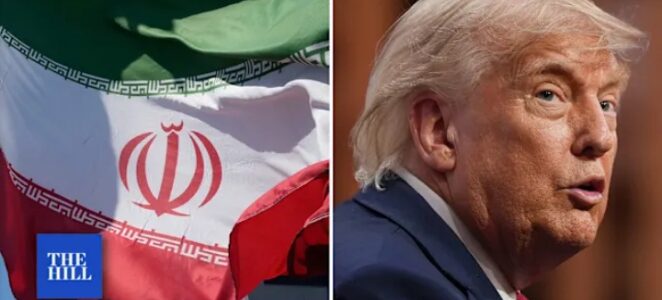
President Trump defended a memorandum of understanding (MOU) released Wednesday that ends the war with Iran, even as he suggested it may not be “permanent” during a press conference from the Group of Seven (G7) summit in Évian-les-Bains, France.
The president noted other G7 members backed the end of the war, arguing it was time for the conflict to end.
He said the war needed to end because of dangers to the global oil supply, even as he suggested new military action could take place against Iran.
The deal sets up a 60-day period of new negotiations on Iran’s nuclear program, the issue that triggered U.S. and Israel attacks on Iran earlier this year.

Here are five takeaways.
Trump suggests the MOU with Iran isn’t permanent
Trump played down the permanence of the preliminary agreement during the news conference, saying it will fall apart if Iran does not honor its terms.
“If they don’t honor the agreement, or some things aren’t even mentioned in the agreement, it’s a memorandum of understanding, but we have an understanding of certain things without writing it,” Trump told reporters.
“If they don’t honor that, we’ll probably go back to bombing them until they honor it,” he continued, adding, “it’s amazing what bombs can do.”
Trump’s comments echoed ones he made earlier Wednesday in which he threatened to bomb Iran “if they don’t behave.”
The president also emphasized to reporters that the memorandum was not final.
“No, it’s not final. It’s a memorandum of understanding, and if I don’t like it, we’ll go back to shooting at them, dropping bombs on their head,” he said.
Trump and Vice President Vance electronically signed the preliminary deal to reopen the Strait of Hormuz on Sunday. The president said Wednesday that the formal, in-person signing could take place Thursday or Friday.
Touts G7 support for ending war, dismisses violation of international law
Trump took a victory lap at the summit as G7 leaders expressed support for the deal in individual statements and a joint communique.
Many appeared to be relieved that the MOU would lead to a reopening of the Strait of Hormuz, through which 20 percent of the world’s oil supply flows.
European powers and Japan alike have been hit hard by higher energy prices as a result of the closure.
Trump lauded the statements, arguing they reflected the value of the deal that was negotiated.
“They all put out statements saying they love this deal because they want to see it,” Trump said, “and they love the fact that the Hormuz — don’t forget if we were going to drop bombs … could be another three months … what do you have left, maybe nothing? But the strait would never be opened.”
Trump dismissed a reporter’s question over whether any of the G7 leaders expressed concern to him that the U.S. violated international law by launching strikes against Iran. Officials in Germany, Italy and France — members of the G7 — initially criticized the war as violating international law.
“No, no, actually the opposite. They felt they [Iran] were very dangerous,” Trump responded.
“They were very relieved because they could get hit too. No, we never discussed that. No, it would be the opposite.”
Trump defends letting Iran maintain missile arsenal
The president defended letting Tehran have its arsenal of ballistic missiles, saying it will be one of the issues not related to Iran’s nuclear program that the U.S. will work on with Persian Gulf allies.
He also suggested it would have been impossible to forbid Iran from having the missiles, which is a serious worry for Israel, when Iran’s rivals like Israel and Saudi Arabia have them.
“I mean, they have to have some, because other people have some. You got to have some,” Trump told reporters Wednesday.
“I like some of these guys, but I … don’t think they’re smart. ‘Sir, you shouldn’t let them have any missile,'” the president said of unnamed advisers. “I said, ‘well, what am I going to do? Am I going to let Saudi Arabia have missiles, but they can’t have them?’ ‘Yes, sir.'”
“Doesn’t work that way, you know, it doesn’t work that way, and missiles aren’t the problem,” Trump said, adding that missiles “hurt a little location, but they don’t blow up the planet.”
Iranian leadership has said that changes to its missile program were one of the red lines during diplomatic talks regarding the potential peace deal. Iran used its program to fire upon Israel and U.S. bases in the Persian Gulf.
“We knocked out probably 84-85 percent of their missiles. The rest of them are underground; they can’t even get them out, you know,” the president responded later Wednesday when asked why it is acceptable for Iran to keep some of that capability.
Trump highlights ‘dispute’ with Netanyahu
Trump put America’s and Israel’s divergent interests over the war with Iran on display during his more than hourlong press conference.
Trump was more reserved in his criticism of Israeli Prime Minister Benjamin Netanyahu, describing the two as having a “dispute” over the threat posed by Hezbollah in Lebanon and advising the Israeli leader to hold back strikes against the U.S.-designated terror group if their strikes avoid killing Israelis or causing significant damage.
Iran has made a ceasefire in Lebanon a priority in the MOU, occupying the first paragraph of the agreement.
“We have a little dispute over Lebanon,” Trump said, referring to Netanyahu.
“I say you can do a little softer touch, Bibi. You don’t have to knock down a building every time somebody walks into it that’s from Hezbollah,” the president continued.
“I’m not saying they shouldn’t protect themselves. I’m saying when two drones are shot into the desert and drop harmlessly, you don’t have to knock down buildings in Beirut.”
Trump’s criticism against Netanyahu struck a softer tone compared with earlier in the week, when he lashed out at the Israeli leader in a profanity-laced tirade.
Trump was reacting to an outbreak of retaliatory strikes between Israel, Hezbollah and Iran over the weekend, saying they almost upended agreement on the MOU.
Trump says gas reserves running dangerously low
The president in his remarks said that oil reserves would have run out in four weeks if the strait had not been reopened.
“We run out of reserves at about four weeks,” Trump said. “You know, there are reserves all over the world, and we would really run out, and there’ll be a time when you wouldn’t be able to get it.”
He said it would be “bedlam” if the oil ran out.
“What this does is it allows the ships to go,” he said of the Iran deal. “If we keep bombing, those ships won’t be going.”
It’s not entirely clear whether Trump was referring to U.S. or global oil inventories. The White House declined to elaborate, referring The Hill back to Trump’s original remarks.
The International Energy Agency (IEA), an organization of oil consuming countries, has warned of declining oil reserves.
The IEA also warned in May that oil demand would exceed supply this year.
Credit: Yahoo News